What Is The Fatality Rate Of Whitewater Rafting?
An honest look at what is and is not known about whitewater rafting fatality rates, the Costa Rican safety norm, and how a guided Class III-IV trip is run.
Fear of the water is the single biggest thing that stops people from booking a rafting trip, and it deserves a straight answer rather than a reassuring slogan. The honest starting point is uncomfortable for both the nervous reader and the confident one: no official, rafting-specific fatality rate for Costa Rica, and no single verified global figure, appears in the primary sources behind this article. Anyone who quotes a precise rate without naming where the number comes from is filling a gap with a guess.
What can be said with confidence is structural. Commercial whitewater rafting in Costa Rica operates under a national technical norm, guides carry safety equipment by law and by practice, and the country's flagship run, the Pacuare, is a rain-fed river whose difficulty moves with the seasons rather than staying fixed. On this site the most reviewed listing, Rafting Pacuare River One Day from Turrialba, holds a 5.0 rating across 385 reviews, and the busiest San Jose departure, From San José: Pacuare River Class 3 & 4 Rafting Day Trip, sits at 4.7 from 291 reviews. Those are review records, not safety statistics, and this article will not pretend otherwise.
It helps to say plainly why the review record still matters to a nervous reader, even though it is not a statistic. A review count is a count of completed trips. Three hundred and eighty-five people came off that Turrialba run, opened their phones, and wrote about it, and the average of their judgments is a perfect five. That does not measure danger, but it does measure that the operation runs, repeatedly and at scale, with guests willing to recommend it afterwards. A trip with a long public trail of completed, praised runs is a very different purchase from a trip nobody has reviewed at all.
There is no single published fatality rate for whitewater rafting that this site's verified sources support, either globally or for Costa Rica. The reason is structural: rafting deaths are counted differently by country, operators are not required to publish incident data in most jurisdictions, and any rate depends entirely on the denominator, whether you count participant-days, trips, or people. A number without its denominator is marketing, not statistics.
The search for a rate fails for a second, less obvious reason: the activity is not one activity. A guided Class II float, a commercial Class III-IV run like the Pacuare's Lower section, and a private creek kayak descent of a Class V waterfall are all "whitewater" in a search result, but they carry completely different risk profiles and completely different participants. Pooling them produces a number that describes nobody's actual day on the water. It is a bit like averaging the crash rates of bicycles, buses and Formula 1 cars and calling the result "the driving fatality rate": technically a calculation, practically meaningless for any individual decision.
There is also a survivorship problem in how rafting incidents become public at all. A private trip that ends in a close call may generate no record anywhere. A commercial trip runs under a permit, with an operator's name attached, and anything that happens on it has an addressable party and usually a news story. That asymmetry means raw incident counts, where they exist at all, tend to over-represent commercial operations relative to private ones, precisely because commercial operations are the ones keeping records. A reader comparing a guided Pacuare trip against a hypothetical unguided alternative is not comparing like with like.
Every Pacuare listing on the roster names its operator and its group ceiling where one exists, and the strongest review records cluster around experienced Turrialba operators. Rafting Pacuare River from Turrialba by Explornatura holds 5.0 from 196 reviews, and Pacuare River by Ticos River Adventures holds 4.9 from 204 reviews. A long review history is not a safety certificate, but a five-star record across hundreds of guests at least tells you the trips ran, repeatedly, and that people came back off the river willing to say so.
For readers who want the wider picture of the river itself, the Pacuare runs about 108 to 133 km depending on the source, from the Cordillera de Talamanca to the Caribbean, and its commercial Lower section is Class III and IV. That is the stretch every day trip on this site runs.
How Is Commercial Rafting Regulated In Costa Rica?
Costa Rica has a national technical norm for rafting, INTE G60-1:2019, which sets minimum ages by rapid class, requires operators to check weather and river conditions, and requires scouting when flow rises. Under its age table, Class IV water is legally open from age 12, Class III from age 8, and Class VI never. The norm is a real, enforceable document, not a voluntary guideline.
The age table is worth seeing in full, because it answers a question parents ask constantly and answers it with law rather than operator cheerfulness:
| Age of participant | Rapid classes allowed under INTE G60-1:2019 |
|---|---|
| Under 5 | None |
| 5 to 7 years | Class I and II |
| 8 to 11 years | Class I to III |
| 12 to 17 years | Class I to IV |
| 18 and over | Class I to V |
| Any age | Class VI never |
The full text of the norm is available at the INTE rafting technical norm, and it is the single most useful document a nervous reader can skim before a trip.
Operators can set their own rules above the legal floor, and several do. On the roster, the listings that state a minimum age say 12, which matches the Class III-IV character of the run. Industry reporting also describes one operator that raises its Pacuare minimum from 12 to 14 between June and November, when water runs higher; that is an operator choice layered on top of the norm, and it is exactly the kind of detail worth confirming on the booking page. Where a listing does not state a minimum age, check the listing rather than assuming.
The scouting requirement deserves a moment of attention, because it is the part of the norm a guest never sees but benefits from most. When flow rises, the norm expects the operation to scout, meaning a guide walks the bank or reads the rapid from the water before sending guests through it. Combined with the weather and river-condition checks, this builds a formal loop between what the river is doing that morning and what the trip does that morning. A reader wondering how a country regulates an activity that changes daily should look here: not at a fixed rulebook of levels, but at a required habit of looking.
Regulation answers half the safety question. The other half is what the crew on your specific raft actually does, which is the next section.
What Keeps A Guided Pacuare Trip Controlled On The Water?
Guided Pacuare trips layer four controls that a private rafter has none of: mandatory helmets and life jackets for the entire trip including calm sections, guides trained in swift water rescue carrying safety kits, a safety briefing with paddle practice before the descent, and on several listings a dedicated safety kayaker shadowing the rafts. None of this eliminates risk, and no honest article should claim it does.
The fresh operator reporting is consistent on these points. Life jackets and helmets are worn for the whole run, not just the named rapids. Guides are trained in swift water rescue and carry safety kits for the full length of the trip. One major operator schedules a 45-minute safety talk and paddle practice immediately before the descent, which is a substantial chunk of a day trip spent purely on preparation. Ticos River Adventures, a family-run operator with more than 30 years on the river, includes dedicated safety kayak support on its Pacuare trips; its two roster listings are Pacuare River, 4.9 from 204 reviews, and Pacuare River Rafting, 4.9 from 27 reviews, the latter listing certified guides, gear, a safety kayak and an insurance policy.
It is worth pausing on why the briefing matters as much as the gear. A helmet protects a head that is already in the wrong place; a briefing tries to keep every head in the right place to begin with. Forty-five minutes of paddle commands, body position and swimmer protocol before the water means that by the time the raft reaches the first named rapid, the crew responds to "forward" and "down" without translating the words first.
Group size is another control, and it varies meaningfully between listings. The roster caps read as follows:
| Listing | Departure | Group ceiling | Review record |
|---|---|---|---|
| Rafting Pacuare River One Day from Turrialba | Turrialba | up to 40 guests | 5.0 from 385 reviews |
| From San José: Pacuare River Class 3 & 4 Rafting Day Trip | San Jose hotels | Not stated | 4.7 from 291 reviews |
| Pacuare River (Ticos River Adventures) | Turrialba | up to 60 guests | 4.9 from 204 reviews |
| Pacuare River Rafting Class IV from Turrialba | Turrialba | up to 18 guests | no rating claim, 4 reviews |
| The Authentic Pacuare River Costa Rica Rafting Tour | San Jose | up to 10 guests | no rating claim, 5 reviews |
| White Water Rafting Pacuare River with Lunch From Puerto Viejo | Puerto Viejo | up to 25 guests | 4.8 from 62 reviews |
A reader who wants a small raft and a lot of guide attention per person can read that table directly: the 18-guest Class IV trip and the 10-guest Authentic Pacuare tour are the intimate end, while the big Turrialba day trips trade intimacy for a long, proven review record and a from price of $99 per person. Neither end is safer by definition; the small trip gives you a lower guest-to-staff ratio, the large trip gives you the statistical comfort of hundreds of guests who have run the same format before you. What you choose depends on which of those two things quiets your particular worry.
This is also where the guided-versus-private distinction matters most. The same river that a commercial crew runs with scouted lines, safety kayaks and trained guides is a very different river for an unguided private group with none of that. Every Pacuare product on this site is a guided trip, and that fact belongs in any honest answer to the fatality-rate question.
Does River Level Change The Risk On The Pacuare?
Yes, and it is the most underdiscussed factor in every "is rafting dangerous" conversation. The Pacuare is rain-fed and runnable all year, but one operator grades it as Class 3+ at low water and Class 4 at high water on the same stretch. A rapid that is a training exercise in March can be a different proposition in November, and operators cancel or reroute in high water or flooding.
The seasonal pattern is well documented. Water is highest and fastest from October to December and lowest from March to April, and rainfall modelled on the Turrialba area, using ERA5 averages, shows February to April as the driest months and the last quarter of the year as the wettest. Operators themselves steer first timers and families toward February to April, and some experienced rafters seek out the bigger water of September and October knowing afternoon thunderstorms are more likely. Several sources note that in the rainy season many Class III rapids become Class IV, and in the dry season Class IV rapids often drop back to Class III.
The seasonal shift is also the cleanest illustration of why a single fatality rate would mislead even if one existed. A rate computed over a year of Pacuare trips would blend gentle March lines with swollen November lines into one average that describes neither month. A nervous reader who books February to April and a thrill-seeker who books October are, statistically, on two different rivers wearing the same name. Seasonality is the variable you control, which is why this section, not the opening statistic, is the one to act on.
Because the Pacuare has no automated flow gauge, river reading is done the old way. A painted rock marker downstream of one lodge and upstream of a footbridge is used as a visual reference, with red-and-higher meaning too high to run; the flow-marker practice is described on the gorafting Pacuare flow page. That is an operator convention, not a government instrument, but it shows how concretely the river is watched, and the fact that trips cancel in high water is itself a safety system working as intended. A cancellation is disappointing on the day and is still the outcome a well-run operator should choose.
For a reader choosing a trip, the practical translation is simple. If you are nervous, book the drier months and say so when you book, because operators can advise on conditions. The From San José: Pacuare River Class 3 & 4 Rafting Day Trip listing, 4.7 from 291 reviews from $125 per person with hotel pickup listed, and the Puerto Viejo departure, 4.8 from 62 reviews from $147 per person, both run the same gorge and both answer to the same seasonality. No operator can promise a river level, and none should try.
What Should You Check On A Listing Before Booking?
Check four things on the operator's live listing: the stated minimum age, the group ceiling, exactly which gear and staff are listed as included, and the cancellation terms. On this roster all but one day-trip listing show free cancellation, and meal arrangements stated plainly, breakfast and lunch on the San Jose and Caribbean departures, lunch on the Turrialba ones.
The inclusions are not decoration; they are the safety picture in miniature. A listing that names a river guide, rafting equipment, a safety kayaker and all fees and taxes, as the Full Day Pacuare River Rafting Experience does (4.8 from 17 reviews, from $124 per person, up to 200 guests), is telling you precisely which layers of protection your money buys. The Two-Day Rafting Tour on the Pacuare River listing goes further, including five hours of rafting, a river guide, rafting equipment, a safety kayaker, accommodation at Avesol Lodge and all fees and taxes, from $370 per person.
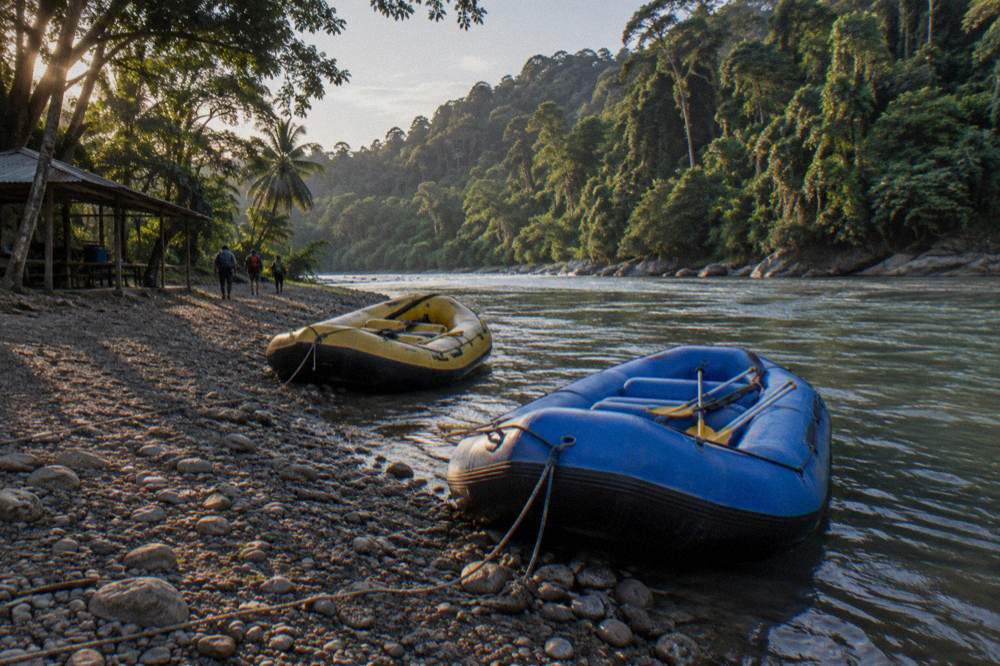
Read the inclusions the way an auditor would. Gear listed by name, helmets, life vests, paddles, means the operator is willing to put the equipment in writing. A safety kayaker listed by name means a second craft and a second trained rescuer on your run. Insurance on the inclusions line, as on the Exploradores Outdoors two-day trip, means there is a policy behind the trip rather than an assumption. Where a listing says only "equipment", the live listing page usually carries the detail, and a question to the operator before booking will settle it. The listing is a legal description of what you bought, which is why this section treats it as the primary safety document it is.
The same reading applies to the multi-day trips, which is why nervous readers should not dismiss them. The 2 Day Pacuare River Rafting and Hiking Tour runs up to 14 guests with one night at Pacuare River Lodge from $375 per person, and the San José Caribe Arenal Pacuare Hiking and Rafting 2-Day Trip includes insurance, transport from San Jose, Puerto Viejo or La Fortuna, and two days on the water from $269 per person. Note that three of the five multi-day listings set longer cancellation windows, 3 to 6 days before departure, which is a planning fact worth knowing before you commit.
Two practical habits close the personal-safety picture. First, footwear: operators recommend tennis shoes or secure sandals and river shoes that can get wet and muddy, and no flip-flops, because a shoe that pulls off in a rapid leaves you barefoot on wet rock. Second, valuables: cameras and phones brought on the raft are the participant's responsibility, and professional photo services are sold separately on several listings, which is the operator's quiet way of saying the river is a hard place on electronics. Neither habit is dramatic, and both are exactly the kind of detail that separates a prepared guest from an improvised one.
So Should The Fatality Question Stop You Booking?
No, but it should make you book deliberately. The verifiable picture is this: a national norm governs the activity, operators layer training, gear, briefings and safety kayakers on top of it, the river's difficulty moves with the season, and hundreds of guests leave five-star reviews on the same run month after month. What does not exist, honestly, is a single fatality rate that would let anyone promise you a number. Anyone who does is selling.
The right response to a missing statistic is to look at the machinery instead. If you want the longest review record on the river, the Turrialba day trip with 385 reviews is it. If you want the smallest groups, pick from the table above. If you want calmer conditions, aim for the February to April window. If you want the full picture of how a first Pacuare day works, read a one-day Pacuare trip walkthrough, and if your real question is whether the whole family can go, start with age limits and fitness for Pacuare rafting. This site, Pacuare Costa Rica Rafting, exists to hold the honest end of that conversation: real listings, real review counts, and no invented numbers where a number should be.
Common Questions About Whitewater Rafting Fatality Rates
What Is The Fatality Rate Of Whitewater Rafting?
No official rafting-specific fatality rate for Costa Rica, and no single verified global figure, was found in the sources behind this site. The honest answer is that the number most articles quote cannot be traced to a primary source, and the more useful question is what protections a specific guided trip actually includes.
Is The Pacuare River Dangerous?
No honest source gives it a safety verdict. Its commercial Lower section is Class III-IV, guided by trained crews under a national norm, and its difficulty rises and falls with rain. Operators cancel or reroute in high water. Difficulty and risk are explained on the river's listings and in the site's rapid-class guide.
What Is The Minimum Age For Class IV Rapids In Costa Rica?
Under the national norm INTE G60-1:2019, Class IV water is open from age 12. Some operators set higher minimums, and one raises its Pacuare minimum to 14 in the wetter June to November window. Always check the listing for the operator's own age rule.
Do The Rafts Have Safety Kayakers?
Several listings on this roster name a safety kayaker in their inclusions, including the Full Day Pacuare River Rafting Experience and the two-day lodge trip from Excitement Costa Rica, and Turrialba operator Ticos River Adventures includes safety kayak support on its Pacuare trips. Where a listing does not name one, do not assume it; check the inclusions list.
Does The Time Of Year Change The Risk?
One operator grades the Pacuare as Class 3+ at low water and Class 4 at high water on the same stretch. Water is highest October to December and lowest March to April, and operators steer first timers toward February to April. No operator can promise a river level on a given day.
What Should I Check On A Listing Before Booking?
Four things: the stated minimum age, the group ceiling, the exact gear and staff on the inclusions list, and the cancellation terms. All but one day-trip listing on this roster show free cancellation; three of the five multi-day lodge listings set longer windows, 3 to 6 days before departure.