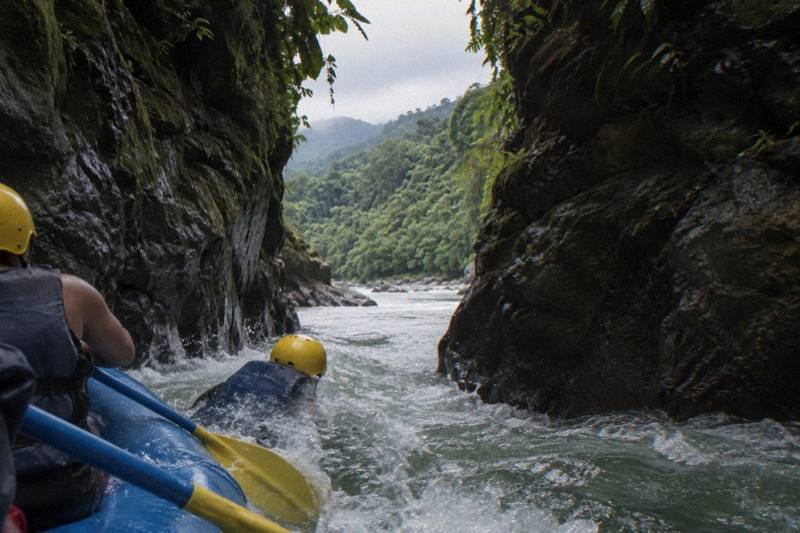
What Not To Wear When White Water Rafting?
Cotton, jeans, flip-flops and other clothing mistakes on a Pacuare rafting trip, with practical Costa Rica fixes and what operators actually provide.
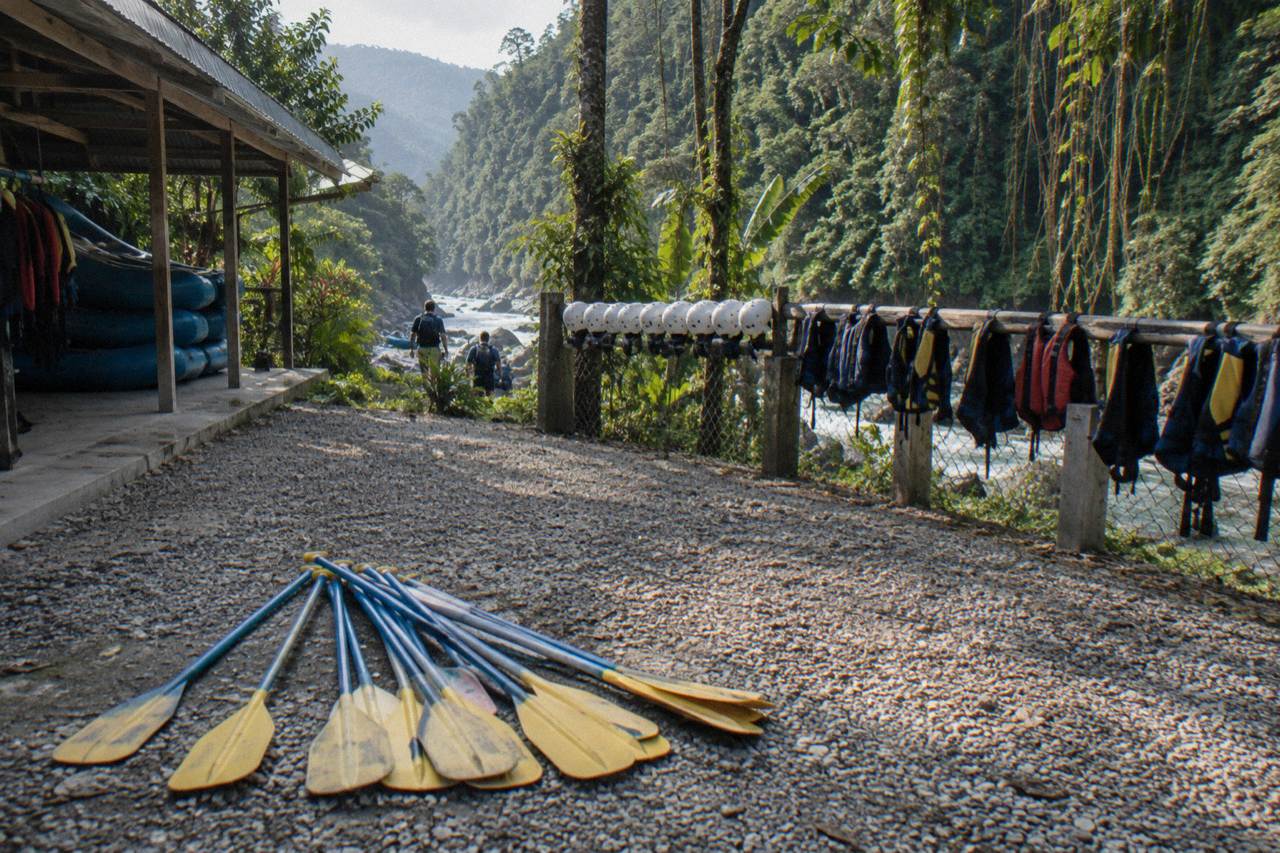
The short list of what not to wear on a whitewater raft is short for a reason: cotton anything, jeans, flip-flops, loose sunglasses without a strap, and anything you would be upset to lose to the river. Operators on the Pacuare provide the helmet, the life jacket and the paddle; everything else you wear is your own choice, and the wrong choice is felt within the first rapid.
The most reviewed day trip, Rafting Pacuare River One Day from Turrialba (5.0 from 385 reviews, from $99 per person), lists helmets, life vests and paddles in the price. That covers the safety gear. It does not cover your shirt, your shoes or your sunglasses, and those are exactly the items guests get wrong.
The four items that fail on every trip are cotton clothing, denim jeans, flip-flops or any unstrapped sandal, and street shoes that cannot get wet. Cotton soaks through and stops insulating, jeans absorb water and sag, loose sandals come off in the first rapid, and leather or canvas shoes take days to dry. Wear quick-dry synthetics and secure footwear and you have solved most of the problem.
Why cotton is singled out deserves a plain explanation. Cotton absorbs water and holds it against your skin, and when that layer of trapped water meets moving air it pulls heat out of your body fast. On a warm Caribbean-slope afternoon this is uncomfortable. In a shaded gorge with wind and splash, it is genuinely cold. Synthetic fabrics, merino wool and modern blends shed water and keep working even when soaked.
Jeans fail twice over. The denim holds liters of water, the seams restrict your legs exactly where you need to brace and kneel in the raft, and wet denim chafes. A guest who rafts in jeans spends the drive back to Turrialba or San Jose in soaked, heavy trousers while everyone else is in dry clothes.
The same logic applies to flip-flops. Guides on the Pacuare, and operator planning pages generally, are explicit: footwear must stay on your foot when you swim, because sooner or later a rapid puts someone in the water. A flip-flop offers zero retention and no protection on rocky banks. One operator planning guide recommends tennis shoes or secure sandals that can get wet and muddy, and says no to flip-flops outright.
Clothing mistakes are cheap to fix before the trip and impossible to fix on the water. The rafting operator brings helmets, life jackets and paddles; you bring the layers underneath. Before the next sections break that down piece by piece, the checklist below is the whole answer in one table.
| Do not wear | Why it fails | Wear instead |
|---|---|---|
| Cotton t-shirts, cotton hoodies | Soaks through, stops insulating, dries slowly | Synthetic or merino base layer, rash guard |
| Jeans or heavy denim shorts | Hold water, restrict movement, chafe when wet | Quick-dry shorts or board shorts |
| Flip-flops, slide sandals | Come off in the first swim, no foot protection | Secure sandals with heel strap, water shoes, old trainers |
| Leather or canvas street shoes | Ruined by water, take days to dry | Cheap sneakers you do not mind soaking |
| Loose sunglasses, no strap | Lost in the first swim | Sunglasses with a retainer strap |
| Jewelry, watches, rings | Lost instantly, snag hazard on ropes and gear | Leave it in the hotel safe or the dry bag |
A useful habit before any Pacuare day trip, including the White Water Rafting Pacuare River From San José listing (4.7 from 250 reviews, from $125 per person, with hotel pickup, breakfast and lunch included), is to ask one question about every item: if this went into the river and stayed there, would I care? If the answer is yes, it stays on the bus.
Why Cotton And Jeans Fail On The River
Cotton and denim fail because they are absorbent rather than wicking, and because a soaked garment does two damaging things at once: it adds dead weight to a swimmer and it dumps body heat through evaporative cooling. A wet cotton hoodie in a gorge wind can leave a guest shivering mid-trip, which is a safety issue, not a comfort issue.
The physics is not complicated. Water conducts heat away from your body far faster than air, so a wet insulating layer can cool you faster than no layer at all. Quick-dry synthetics do not trap water in the fibers the way cotton does. Merino wool keeps a meaningful share of its insulating value even soaked. That is why paddling gear, swim shirts and board shorts dominate what experienced rafters wear.
Jeans add a mechanical problem on top of the thermal one. Rafting is not sitting still: you brace your feet under thwarts, kneel, climb in and out over wet tube rubber, and sometimes walk on slippery rocks. Wet denim resists all of that. The seams bind at the knee, the waistband sags with water weight, and the fabric takes the rest of the day to dry in a humid climate.
There is a second, quieter problem with heavy clothing: it affects how you swim. If you come out of the raft, the trained position is on your back, feet up and pointed downstream. Several kilograms of trapped water in a pair of jeans makes that position harder to hold and heavier to rescue. Lightweight layers are not just about comfort, they change what a swim looks like.
More of these guides are collected on Pacuare Costa Rica Rafting.
What Footwear Works And What Does Not
Footwear is the clothing rule that matters most on the river. The failures are flip-flops, slide sandals, bare feet and dress shoes. The passes are sandals with a heel strap, purpose-built water shoes, or cheap trainers with a decent lacing system. The test is simple: kick your foot hard underwater and see whether the shoe is still on when it comes up.
The reason footwear matters more than any other garment is that your feet are your connection to the raft and your protection on the bank. Guides instruct rafters to brace feet under the tubes in rapids. On shore, put-ins and take-outs involve wet rocks, gravel and mud. A bare foot or a flip-flop on that terrain is a twisted ankle waiting to happen, and an unstrapped sandal that floats downstream is litter.
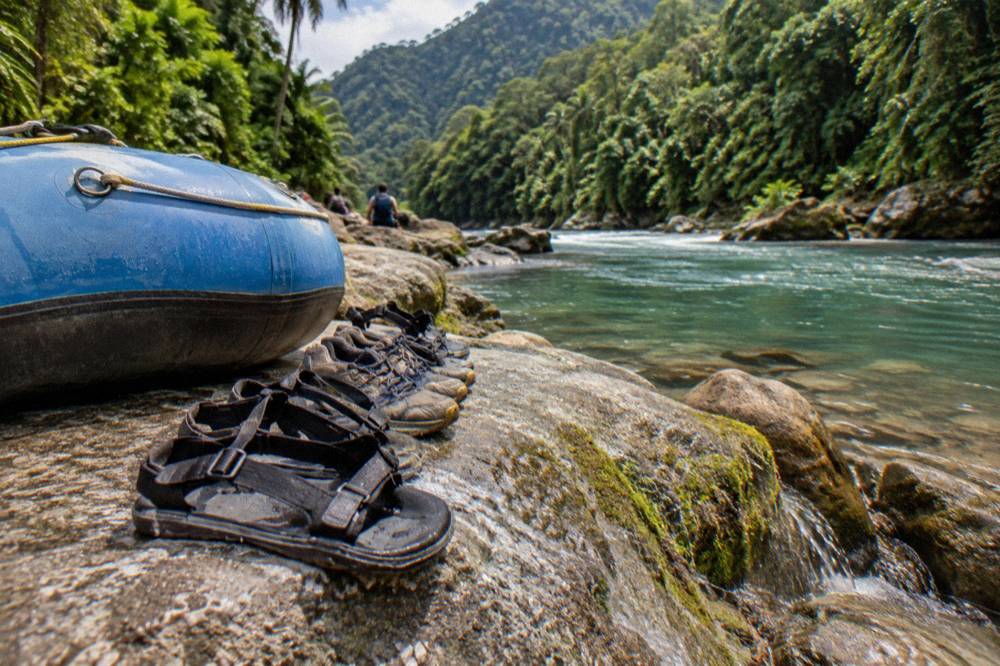
One question that comes up often, and that deserves its own answer, is whether rubber clogs count as river footwear. The short version is that they fail the retention test: the heel strap on most clogs is a loose band, not a locked harness, and pools of standing water fill the toe. The site's dedicated piece on clogs as rafting footwear goes through the arguments in detail.
What actually works:
| Footwear | Retention | Protection | Verdict |
|---|---|---|---|
| Water shoes (purpose-built) | Excellent | Good sole, closed toe | Best all-round choice |
| Sandals with heel strap (secure type) | Good | Good sole, open toe | Fine, watch the toe |
| Old trainers, snug laces | Good | Good, drains poorly | The budget classic |
| Rubber clogs | Poor | Moderate | Fails the swim test |
| Flip-flops, slides | None | None | Do not bring them |
Two footnotes from operator guidance. First, lace your trainers properly, because a half-tied shoe sheds exactly like a sandal. Second, expect mud: the take-out areas after rain are slick, and the shoes that survive a Pacuare trip are the ones you were happy to sacrifice before you left home. The La Fortuna departure with shuttle to San Jose airport or Puerto Viejo, La Fortuna: Pacuare Rafting with SJO or Puerto Viejo Shuttle (5.0 from 20 reviews, from $150 per person), is a reminder that you may be heading straight to a flight or a beach afterward, which makes quick-drying footwear even more valuable.
What To Wear Instead: A Layer-By-Layer Fix
A working rafting outfit is four pieces: a quick-dry top such as a rash guard or synthetic tee, quick-dry shorts or board shorts over a swimsuit, secure river footwear, and a warm dry layer waiting in the bus for the take-out. The operator supplies helmet, life jacket and paddle. Sun protection, a strap for glasses and a towel complete the kit without adding weight.
Build it from the skin out. The base layer is a swimsuit or synthetic underwear, never cotton. The mid layer is the rash guard or athletic top; long sleeves earn their place on the Pacuare because the tropical sun is fierce and the gorge walls do not always shade you. Legs get board shorts or running shorts with a drawstring. Everything should be something you would happily swim in.
The dry layer is the piece people forget. After the take-out there are showers and changing facilities at the operator centers before the return drive, and on a San Jose departure with a long ride back, a warm dry top transforms the last two hours of the day. Pack it in a bag that stays on the bus, not on the raft.
For the upper body, remember the life jacket covers most of your torso, so elaborately printed shirts are partly wasted. What the jacket does not cover are your arms, the back of your neck and your legs, which is where sunscreen belongs, applied before the safety talk because it needs time to bind and the operator will not wait.
The gear you do not need to bring is the expensive part. The most reviewed Turrialba listing, Rafting Pacuare River One Day from Turrialba, includes helmets, life vests and paddles in the price, along with a typical Costa Rican lunch at the end of the trip. Nobody should buy a helmet or a PFD for a commercial Pacuare trip.
Sun, Rain And Seasonal Clothing On The Pacuare
The Pacuare runs all year, and what to wear shifts with the calendar rather than with fashion. In the drier February to April window, sun protection dominates: long sleeves, sunscreen, a cap under the helmet. In the wetter second half of the year, a light rain shell for the bus and a synthetic layer for the river matter more, because you will be wet and possibly wind-chilled in the gorge.
Operators describe February to April as the preferred window for first timers and families, with lower and more predictable water. October to December is the highest-water period. Clothing follows: in high water you splash harder and swim colder, so a rash guard plus a synthetic layer beats a single cotton tee in every scenario. The water itself is not the problem, the Pacuare runs at about 21 C (70 F) and warmer with no wetsuit needed, it is the wind on wet fabric in the gorge.
Rain on a rafting trip is mostly a non-event; you are going into a river. What rain changes is the before and after: the walk to the bus, the changing area, the drive home. A light shell and a dry bag or plastic bag for the wet clothes handle all of it. Guests on the Puerto Viejo departure, White Water Rafting Pacuare River with Lunch From Puerto Viejo (4.8 from 62 reviews, from $147 per person), get lockers and changing facilities included, which makes the wet-to-dry handoff easy.
The sun is the underestimated hazard. Reflected glare off the water hits your face and the inside of your knees, and a helmet does not shade your neck. A bandana under the helmet straps, sunglasses with a retainer strap, and sunscreen reapplied at the riverside lunch are the standard fixes. A strap costs a few dollars and is the difference between keeping and losing your sunglasses on day one of a two-day trip.
Seasonality also affects the minimum ages some operators set, with at least one raising the Pacuare minimum from 12 to 14 in the wetter June to November months. Clothing cannot fix an age rule, but it is a useful reminder that the same trip is a different physical experience in March than in October, and the wardrobe should scale with it.
What About Glasses, Jewelry And Electronics?
Leave jewelry and watches in the hotel safe, put sunglasses and prescription glasses on a retainer strap, and treat any phone or camera you bring on the raft as a likely loss. Operators state that valuables carried on the water are the participant's responsibility, and optional professional photo services exist precisely because personal devices and rapids do not mix.
Rings are the classic casualty. Cold water shrinks fingers slightly, paddle handles and rescue lines snag metal, and a ring lost to a river is gone. A watch, even a waterproof one, takes impacts against the tube and the paddle. The zero-cost fix is to remove all of it before the drive to the put-in and leave it somewhere with a door.
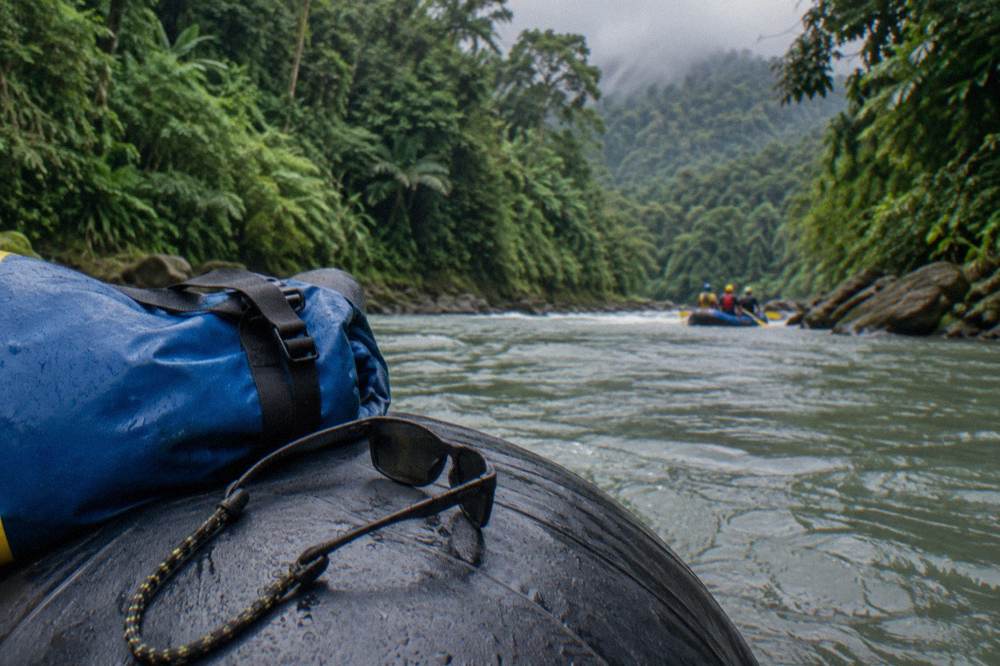
Prescription glasses are a genuine planning problem rather than a preference. If you cannot function without them, wear them with a sports strap that locks behind the head, and accept the risk explicitly. Contact lenses plus strap-on sunglasses is one workable combination, with a spare pair of lenses in the dry bag as backup.
Phones deserve a blunt rule: no phone on the raft unless it is in a properly sealed case tethered to your body. Several listings on this site, including the San Jose day trip, note souvenir photos as a paid extra, which is the operator's answer to the same problem.
Wetsuits, Water Temperature And Cold-Weather Layers
On the Pacuare a wetsuit is unnecessary: the water is about 21 C (70 F) and often warmer, and operator guidance says as much. Wetsuits matter on snowmelt rivers, not tropical ones. What earns a place in your bag is a synthetic layer for wind chill in the gorge and a fleece for the air-conditioned drive home.
The contrast confuses travelers who have rafted in North America or Europe, where cold rivers make wetsuits standard rental items. On a Caribbean-slope river at tropical latitude, the thermal problem runs the other way: overheating on the flat stretches, then a short chill in a shaded gorge with spray. A single quick-dry layer handles both. Thick neoprene would cook you by lunch.
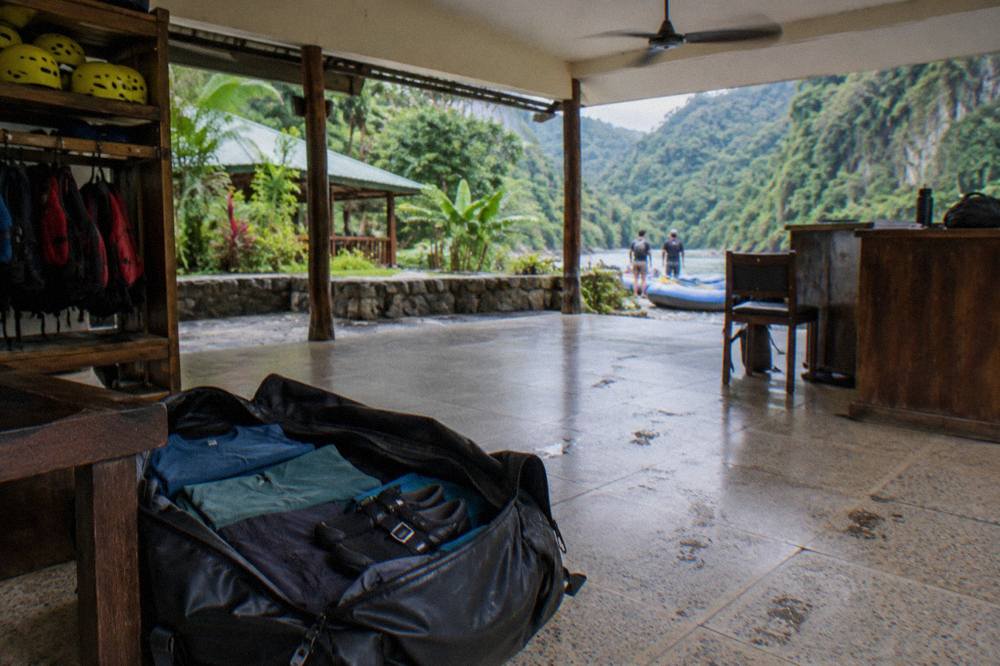
Where cold does sneak in is logistics. Buses run air conditioning, the return drives from the river to San Jose are long, and you will be sitting in wet clothes unless you change at the take-out. Changing facilities and showers are common at the operator centers. The fix costs nothing: a dry top, a towel and dry footwear in the bag that rides the bus.
For multi-day guests the layering question grows. The two-day trips, such as the 2-Day Tour of the Pacuare River in Costa Rica (from $397 per person, with breakfasts, lunches and dinner), include an overnight at a riverside lodge, so a second dry set of clothes for the evening and a dry pair of shoes for camp are worth their weight. You cannot dry wet clothes in the rainforest overnight; you can only replace them. Pack accordingly, and remember that cancellation windows on lodge trips are set per listing, on three of the five several days before departure, so clothing questions should be settled before booking rather than after.
A Packing Checklist For Your Pacuare Trip
Pack a swimsuit worn under quick-dry shorts, a synthetic or long-sleeve rash guard, secure river shoes, sunscreen, sunglasses with a strap, a towel, a complete dry change of clothes and dry footwear for the bus. Leave behind cotton, jeans, flip-flops, jewelry and any device you cannot afford to lose. The operator provides helmet, life jacket, paddle and, on most listings, lunch.
The checklist is short because the operator carries the heavy inventory. Operators provide helmets, life vests and paddles. Meals vary by listing and are stated on each roster line: the San Jose departures typically include breakfast and lunch, while the Turrialba day trips include lunch. Read your specific listing's inclusions rather than assuming, because departure towns and operators differ.
Two habits separate well-dressed rafters from soggy ones. First, rig for swimming: assume you will end up in the water at least once and dress so that this is fine. Second, bag the transition: one bag for wet gear, one dry bag for the ride home, nothing loose in the bus. Guests on Class IV-focused trips, like Pacuare River Rafting Class IV from Turrialba (from $125 per person, 8 hours, lunch included), spend more time in spray than most, and the same rules apply with less slack.
For deeper planning beyond clothing, the site's guides cover what to wear rafting in Costa Rica across seasons, and the trip-by-trip comparison page matches departure towns and budgets to specific listings.
Common Questions About Rafting Clothing
What Not To Wear When White Water Rafting?
Do not wear cotton clothing, jeans, flip-flops or unstrapped sandals, loose sunglasses, jewelry, or any shoe that cannot get soaked. Cotton and denim hold water and chill you, loose footwear comes off in rapids, and small valuables go straight to the river bottom. Wear quick-dry synthetics, secure river shoes and a strap on your glasses.
Do I Need A Wetsuit On The Pacuare River?
No. The water runs about 21 C (70 F) and warmer, and operator guidance states no wetsuit is needed. A quick-dry layer for wind chill in the gorge and a dry fleece for the return drive do more for your comfort than neoprene ever would on a tropical river.
Can I Wear Flip-Flops Rafting?
No. Operator planning pages are explicit that flip-flops are not acceptable river footwear because they provide no retention and no protection. Wear water shoes, sandals with a secure heel strap, or old trainers with snug laces, anything that survives a swim and grips wet rock.
Can I Bring My Phone Or Camera On The Raft?
Only in a properly sealed case tethered to your body, and at your own risk: operators state that valuables carried on the water are the participant's responsibility. Several listings offer professional souvenir photos as a paid extra, which is the safer way to return with pictures.
What Should I Wear After The Trip?
A complete dry change of clothes and dry footwear, packed in the bag that stays on the bus. Take-out centers have showers and changing facilities, and return drives to San Jose or the coast are long enough that sitting in wet clothes is the day's avoidable misery.