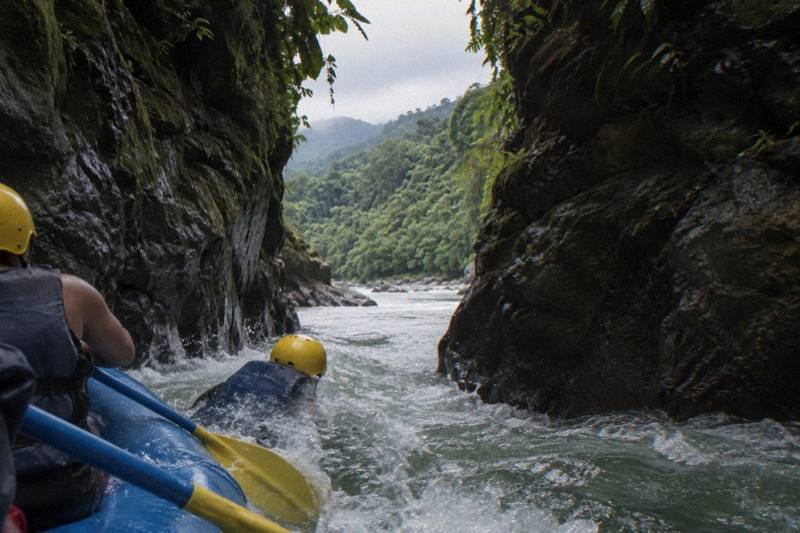
Are Crocs Ok For Rafting?
A straight answer on Crocs for Pacuare River rafting, what operators require, and the footwear that actually stays on your feet through Class III-IV rapids.
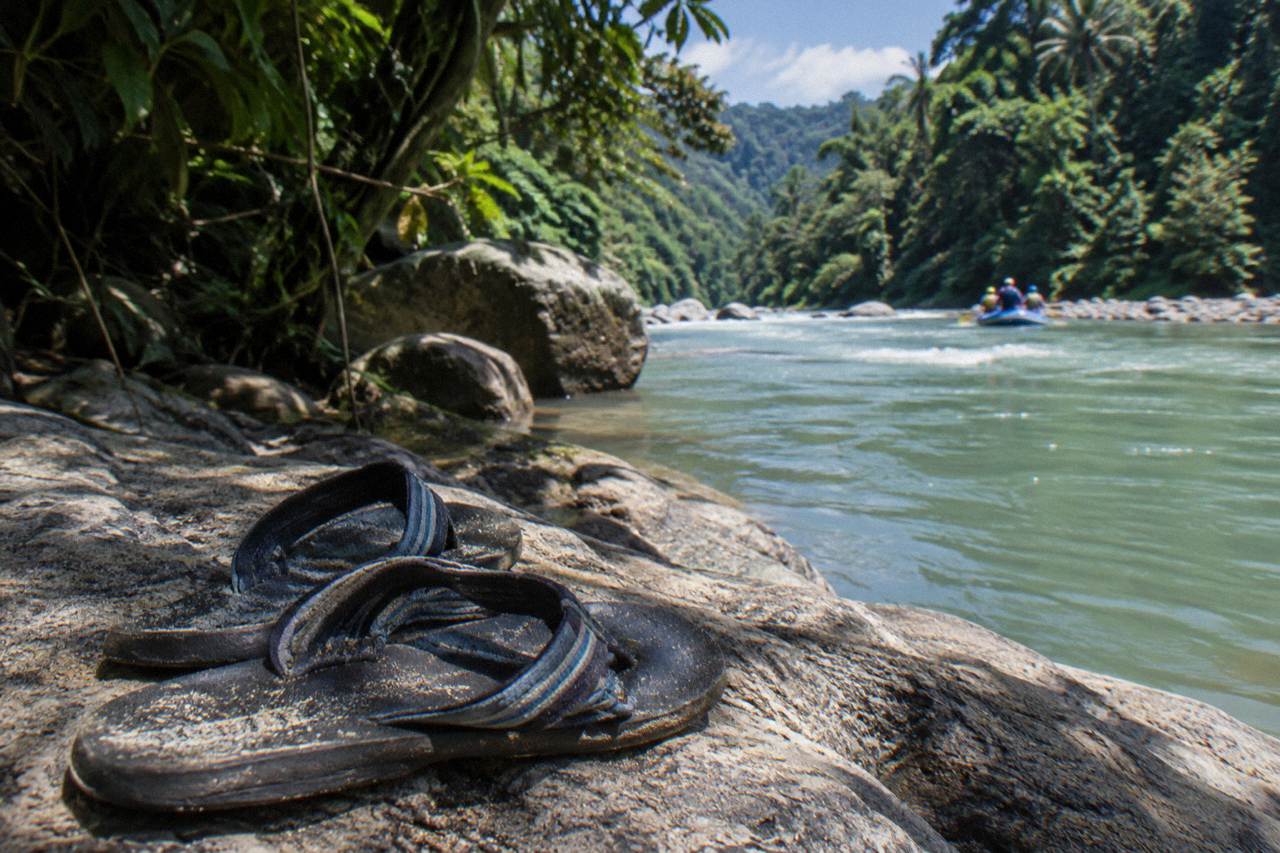
The Crocs question comes up for a simple reason: most travelers already own a pair, they dry fast, and packing a second river shoe feels wasteful when luggage space is tight. The Pacuare runs Class III-IV rapids through a gorge with wet rocks, silt banks and gear-laden rafts on both ends of the day, and footwear failures on that terrain are not a small problem. This page gives the straight answer, explains what operators on this river actually require, and lists what works instead, tied to the real bookable trips where these rules apply. If the Class IV stretch is what gives you pause about booking, our beginner's guide to running Class 4 rapids explains who can handle this river safely.
The short version, and it is worth being blunt here: loose Crocs are a poor fit for the raft, and the standard line on operator planning pages is secure sandals or tennis shoes that can get wet and muddy, never flip-flops. Classic Crocs in sport mode, with the heel strap engaged, sit in a gray zone. None of the listings on this site's roster require you to buy specialized river shoes. The clear risk is that loose, unstrapped Crocs and flip-flops come off in the first rapid and are a hazard to you and to the swimmer behind you.
On the Pacuare's Class III-IV run, the answer is a qualified no: Crocs worn loose are a poor choice, Crocs with the heel strap fastened are not the recommended choice, and what operators ask for is tennis shoes or secure sandals with a heel strap. Helmets, life jackets and paddles are provided, so footwear is the one piece of kit you bring yourself, and the one thing that can genuinely sink your day.
Here is the reasoning, and it is worth reading before you decide. A Pacuare day trip is not a float on a lake. The run is mostly Class III-IV water through a jungle gorge, and the risk moments are not only in the rapids. They happen on the put-in bank, where rocks are wet and slick with silt. They happen during the safety talk, when you walk down to the water carrying a paddle. And they happen if you swim, when your feet are your first contact with whatever is under the surface.
Crocs fail in three specific ways on that terrain. First, the classic unstrapped clog has nothing holding it to the heel, so the first wave that hits your feet takes the shoe and sends it downstream. Second, the foam sole, grippy on dry tile, is famously poor on wet sloping rock, which is exactly what a Pacuare bank is made of. Third, the vent holes that make Crocs dry quickly also let in gravel and sand, which turns a long bus ride home into an hour of picking stones out from under your arch.
The published guidance from operator and guide pages on this river is consistent. Planning pages for Costa Rica rafting trips recommend tennis shoes or secure sandals and river shoes that can get wet and muddy, and specifically call out that flip-flops do not count. Life jackets and helmets are mandatory for the whole trip, including calm sections, per the safety pages operators publish; footwear is the guest's responsibility within those guidelines. One detailed operator guide states the footwear rule plainly alongside the rest of the kit list, and you can read the same recommendation on independent Costa Rica trip pages that cover the Pacuare specifically: secure footwear that can get wet, no flip-flops.
So where does that leave the pair of Crocs in your closet? In sport mode, with the strap rotated forward and snug, they tick the "stays on the foot" box. But the sole grip problem does not go away, and on a river where one operator describes its run as Class 3-plus at low water and Class 4 at high water, the margin between a slipped step and a twisted ankle is thin. If Crocs are genuinely your only option, strap them, size them tight, and read the section later in this page on making them work. If you have a week before your trip, buy or pack something better.
What Footwear Do Pacuare Operators Require?
No listing on this site's roster states a formal footwear requirement; what exists is the operator-published packing guidance, which asks for secure shoes that can get wet. Helmets, life jackets and paddles are provided on the roster's day trips; shoes are the guest's own gear.
The kit split matters for planning. On the featured Turrialba day trip, Rafting Pacuare River One Day from Turrialba, the listing states the operator provides helmets, life vests and paddles, plus a typical Costa Rican lunch at the end of the trip and private transportation, all from $99 per person, with 5.0 across 385 reviews making it the most reviewed trip on this roster. It says nothing about shoes, which is normal: footwear is assumed to be the guest's problem. The same pattern holds across the one-day San Jose listings, where breakfast and lunch are listed inclusions and footwear never appears.
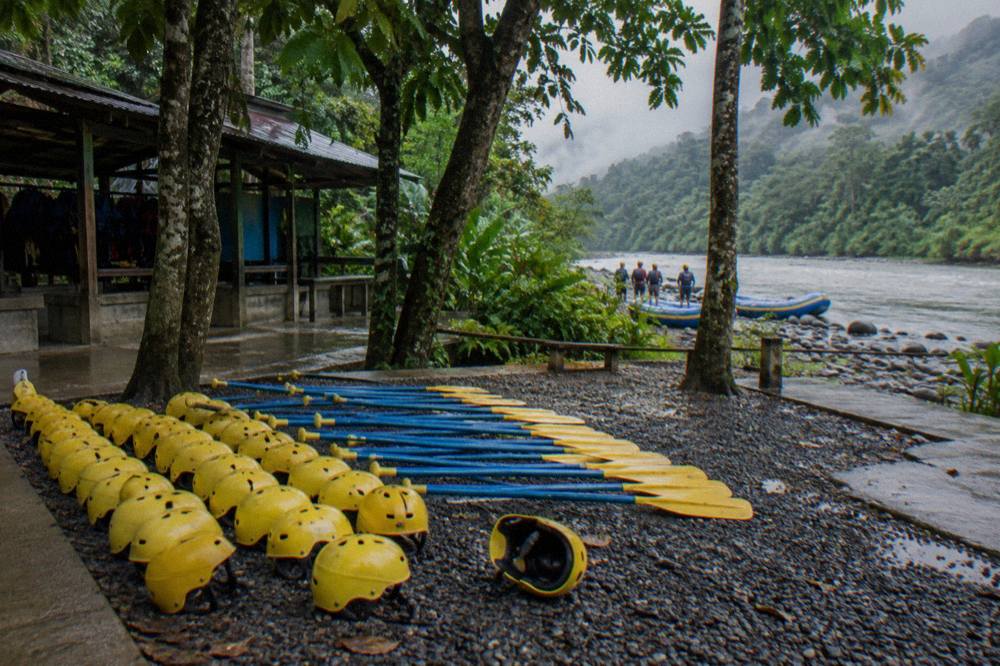
What the published sources say instead is guidance, and it converges. Costa Rica rafting guides recommend tennis shoes or secure sandals and river shoes that can get wet and muddy, and rule out flip-flops outright. Valuables brought on the raft, including cameras and phones, are the participant's own responsibility, with professional photo and video services sold separately on many trips, and the same logic extends to footwear: bring the wrong thing and no operator can fix it at the put-in. The footwear and packing recommendations appear on independent Costa Rica rafting pages too, including this Pacuare-specific planning guide, which lists secure water shoes among its practical kit advice.
The practical consequence for your booking is simple. If you are taking the one-day trip from San Jose, White Water Rafting Pacuare River From San José, from $125 per person with hotel pickup from selected San Jose hotels, breakfast and lunch included and free cancellation listed, your packing list is short: swimwear or quick-dry clothes, sunscreen, a towel, a change of clothes for after, and shoes that strap on. That is the whole list. The trip itself is 10 hours door to door with the drives, so the shoe decision is the single piece of gear prep you cannot outsource. Rafters staying in Turrialba can skip most of that drive with Explornatura's 6-hour day trip, 5.0 from 196 reviews, from $120 per person.
A note on what "secure" means in practice, because the word does a lot of work. A secure sandal has a heel strap and at least one forefoot strap, both adjustable, both buckled rather than velcro-only, because velcro saturates with sand and stops holding. A tennis shoe or trail runner is secure by default if it is laced properly. A clog with a swivel strap is borderline. A slide, a flip-flop, or a bare sock is not in the conversation.
Why Crocs Fail On Whitewater
Crocs fail on whitewater for three concrete reasons: the unstrapped clog has no heel retention and washes off in the first wave, the foam sole loses grip on wet sloping rock at the exact put-ins and take-outs where most slips happen, and the vent holes pass gravel and sand into the shoe during a swim. None of these are Croc-hating folklore; all three are mechanical failures you can test yourself on a wet rock.
Start with retention. In a Pacuare rapid, water comes over the bow and over your feet constantly. A shoe held only by friction against the top of your foot needs very little lateral force to strip off, and a swimmer's feet are the first thing dragged. Guides on this river are trained in swift water rescue and carry safety kits for the full length of the trip, as the operator safety pages describe, and a lost shoe in a gorge with no road access is simply gone. You will finish the day with one shoe on a bus.
Then grip. Croslite foam is comfortable and light, and its traction on dry surfaces is fine. On wet rock, especially the silted, sloping banks where rafts launch and land, it is well below a rubber-soled sandal or shoe. On the put-in walk you are carrying a paddle, the bank is uneven, everyone is rushing, and the rocks are wet from the last group. This is where the wrong sole shows up, not in the rapid itself.
Then debris. The vent holes that make Crocs dry in an hour also make them a colander. A swim in a shallow rapid pushes sand, gravel and small stones into the shoe, under your heel, and you will feel every one of them for the rest of the day. The independent trip pages that cover Pacuare logistics describe post-rafting time at Siquirres-area centers with showers, changing facilities and lunch before the return drive, and that is where you will be emptying your shoes out.
Finally, the honest counterpoint. Crocs in full sport mode, strap forward and snug, are worn by real guests on real trips. The question is not whether it is possible, it is whether you want your thinnest-grip footwear on the one day of your trip with the highest slip consequence, when an old pair of running shoes would have done the job better for free.
What Shoes Work Instead?
The three categories that work on the Pacuare are closed shoes that can get wet, such as running shoes or trail runners with good laces, proper strapped sandals with a buckled heel strap, and purpose-built river shoes. Old sneakers you were going to retire are the single best value option: free to you, grippy, closed against gravel, and nobody cares if they never dry.
Here is the comparison in one place, with the trade-offs that matter for a one-day or two-day Pacuare trip.
| Footwear | Retention | Wet-rock grip | Gravel protection | Verdict for the Pacuare |
|---|---|---|---|---|
| Old running shoes, laced tight | Excellent | Good | Full | Best free option |
| Strapped sports sandals (buckled heel strap) | Good to very good | Good | Partial | Best hot-weather option |
| Purpose-built river shoes | Excellent | Very good | Full or near-full | Best if you already own them |
| Crocs, sport mode, strap snug | Borderline | Poor to fair | Poor | Tolerated, not advised |
| Crocs, strap back or slides | None | Poor | Poor | Do not wear |
| Flip-flops | None | Poor | None | Banned by every guideline |
Two notes on that table. First, on laces: double-knot them and tuck the ends, because a loose lace in a raft is a tourniquet waiting for a rope. Second, on socks: a thin pair of synthetic socks with running shoes reduces gravel abrasion dramatically and costs nothing; cotton socks stay wet all day, so skip them.
If you are buying rather than raiding the closet, the thing to check is the sole, not the brand. You want rubber, you want lugs or a textured pattern, and you want it to bend but not fold. Anything marketed as a water shoe with a buckled heel closure will serve. Anything with the word "slide" in the name will not.
For the two-day trips the calculus gets slightly more serious, because you are on the river across two days and a footwear failure costs more. The 2-Day Tour of the Pacuare River in Costa Rica, from $397 per person, Class III-IV, departing Siquirres, with breakfast, lunch and dinner included and a full-refund cutoff of 6 days before departure per the listing, is a lodge overnight: you want shoes that dry overnight at a jungle lodge, which means a second pair or a quick-dry sandal, because soaked running shoes in humid rainforest air do not dry by morning.
Can You Wear Flip Flops Or Go Barefoot?
No on flip-flops: every operator guideline and independent Pacuare planning page rules them out flat, because they have zero retention and wash away in the first wave. Barefoot is more nuanced but also a no on the commercial run, because put-in banks, take-out rocks and lodge trails hold gravel and foot-hostile debris, and a lacerated sole ends your trip.
The flip-flop rule is the one point of total agreement across the sources. The same pages that recommend tennis shoes or secure sandals list flip-flops as the thing not to wear, and the reason is retention, full stop. A flip-flop held by a toe post cannot survive even a calm stretch at paddling speed, and the Pacuare's calm stretches are brief.
Barefoot deserves a fairer hearing, because experienced river people do run rivers barefoot in some contexts, and on a hot day it feels natural. But on a commercial Pacuare trip the walk to the raft, the walk out of the raft, and on multi-day trips the trails around the lodges are all barefoot hazards. You are also on a schedule with a group: a cut sole at 10:15 in the morning means paddling in pain. Neither is the day you paid for.
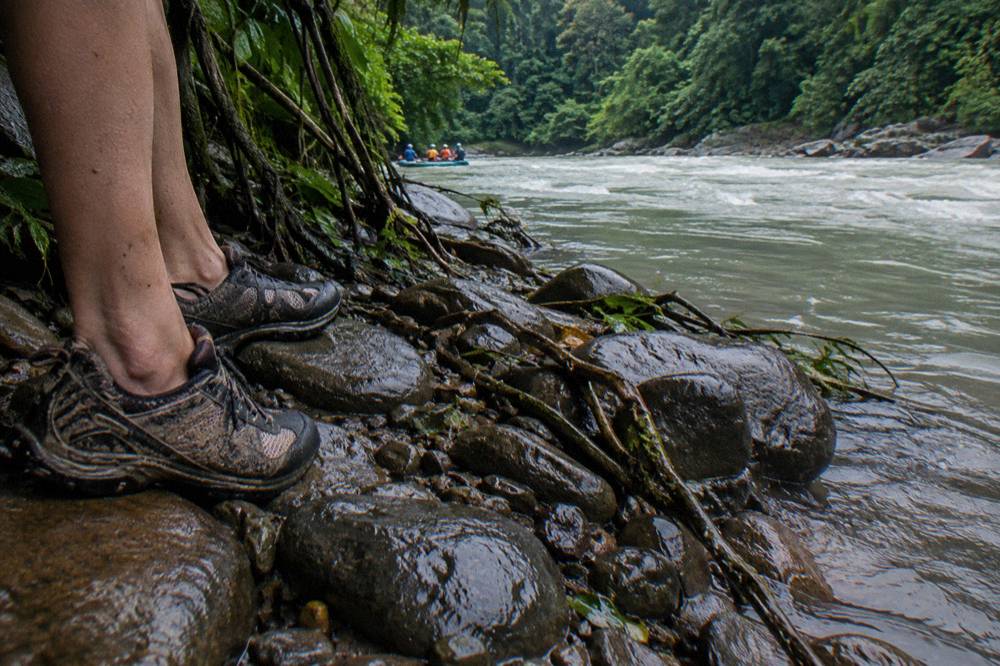
What about water socks and thin neoprene booties? These sit between categories. Neoprene booties with a rubber sole work well and are cheap; the failures come from thin "aqua socks" with sock-fabric soles, which have the grip profile of a sock and tear on the first sharp rock. If it has a real rubber outsole and a snug closure, it qualifies. If you can fold the sole in half with one hand, it does not.
The pattern across all of this is that the operator provides everything dangerous and everything technical, and the guest provides everything personal. On the roster's Turrialba day trips, from the 6-hour Rafting Pacuare River from Turrialba at from $120 per person with 5.0 from 196 reviews, to the Class III-IV Pacuare River Rafting listing at from $119 per person with 4.9 from 27 reviews, the pattern is identical: guides and lunch on the operator's side, shoes and a change of clothes on yours. Nail the shoe question and the rest of the day is logistics.
Footwear Rules For Kids And Teens On The River
Kids and teens need shoes held to the same retention rules as adult footwear, sized so they cannot be kicked off in a rapid. Age limits, usually 12 on the Pacuare's Class III-IV stretch and sometimes 14 in the wetter months, decide who can raft at all, but the footwear standard stays identical for younger paddlers.
Kids' footwear fails differently from adult footwear, mostly through sizing and through the kick-off reflex. A child who swims will kick, and a half-size-too-big sandal will not survive it. The same guidelines apply with extra force: closed shoes, laced and double-knotted, or a buckled strapped sandal. Crocs on children combine every failure mode above.
The age rules matter here because they shape which trip a family can even book. Among the San Jose departures, the 10-hour White Water Rafting Pacuare River From San José states a listing minimum age of 12 with up to 20 guests, and the Puerto Viejo departure, White Water Rafting Pacuare River with Lunch From Puerto Viejo, from $147 per person with 4.8 from 62 reviews, also states minimum age 12. Other listings on the roster say "check the listing" for age, so confirm before booking rather than assuming. Operators set their own minimums and sometimes raise them when the water is high, as the season guidance from operator pages describes: one operator raises its Pacuare minimum age to 14 from June to November when water runs higher.
For a family planning around these limits, the practical packing list is unchanged: every person in the raft needs shoes that stay on. That is the whole rule, and it is the same rule this page has been repeating in different forms, because there is genuinely only one rule.
How To Pack Footwear For Trip Day
Wear your river shoes on the van and keep a dry pair plus socks in your day bag, since post-rafting logistics at the Siquirres-area centers commonly include showers and changing facilities before the return drive. Switching into dry shoes after six to ten hours in wet ones is the difference between a good ending and a squelchy bus ride, so bring nothing you would mourn losing to the river.
The day itself is long, and that shapes the packing. San Jose departures typically involve early morning pickups, with one operator's published schedule showing 6:00 to 6:30 a.m. hotel pickups and returns around 5:30 p.m., breakfast at the river center, a 45-minute safety talk and paddle practice, roughly three hours on the water, then shower, change and lunch before the drive back. Turrialba departures are shorter: operators such as Adrenalina run one-day trips from around 8:00 a.m. from the Turrialba area, roughly six hours total, with lunch at the end. The featured Turrialba day trip follows exactly that pattern.
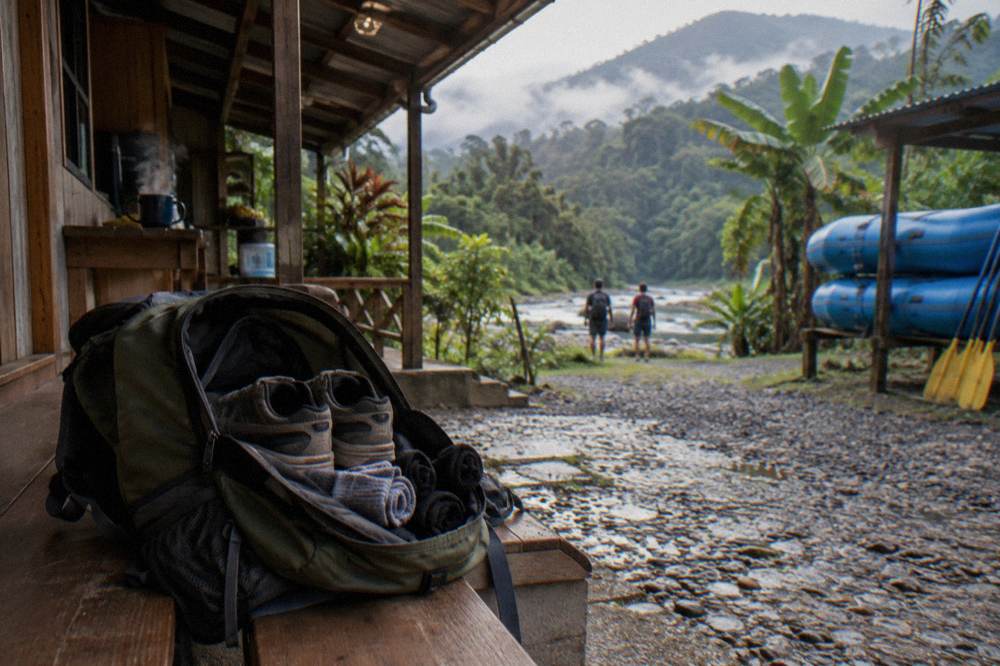
The footwear-specific packing sequence, in order:
- River shoes on your feet when you board the van. They will get muddy on the bank before the raft, so do not wear them to breakfast at the hotel in their pristine state and then transfer; just commit.
- Dry shoes, socks and underwear in a small bag that stays on the bus or in a locker. Several listings mention lockers or changing facilities; where a listing does not, ask at check-in.
- Nothing valuable in your river shoes or pockets. Phones and cameras on the raft are your own risk, and souvenir photos are sold separately on several listings.
- If you wear Crocs despite everything, engage the strap, and add a cheap heel-strap retainer or simply accept the risk knowing a swim probably costs you the shoe.
One more thing worth saying plainly: the phone in your Croc vent hole is not a secure mounting system. Buy the photos. They are cheaper than a phone and a shoe.
The final framing, before the questions: footwear is the one decision on a Pacuare trip that no operator can make for you, and it is also the cheapest to get right. A retired pair of running shoes in the bottom of your closet beats every clever option on this page, and the trips themselves, whether the most reviewed Turrialba day trip at from $99 per person, the San Jose departure with hotel pickup at from $125 per person, or the two-day lodge trip at from $397 per person, take care of literally everything else. This site's Pacuare Costa Rica Rafting homepage comparison walks the full trip choice if the shoe question was the last thing between you and a booking, and the separate what to wear rafting guide covers the rest of the outfit question beyond shoes. For the complete kit list including dry bags and sunscreen, see the what to bring for a Pacuare trip guide.
Common Questions About Crocs And Rafting
Are Crocs Ok For Rafting?
Loose Crocs, no. Crocs with the heel strap engaged are not the recommended footwear for a Class III-IV Pacuare run, because the sole grips poorly on wet rock and the vent holes let in gravel. Operators ask for tennis shoes or secure sandals that can get wet; an old pair of running shoes is the best free option.
Do I Need To Buy Special River Shoes For The Pacuare?
No. Helmets, life jackets and paddles are provided on the roster's trips, and the only footwear requirement in operator guidance is shoes that stay on and can get wet. Old sneakers laced tight meet that bar completely.
Can I Wear Flip-Flops On The Raft?
No. Every operator guideline and independent Pacuare planning page rules flip-flops out, because a toe post cannot hold a shoe on in moving water. Wear them to the van if you like, but change before the put-in.
Should Kids Wear Crocs On A Rafting Trip?
Not advised. A kicked-off shoe is a lost shoe. Closed shoes double-knotted, or a buckled strapped sandal sized correctly, are the same rule as for adults, applied with more force.
What Shoes Should I Pack For A Two-Day Pacuare Lodge Trip?
Bring two pairs: one wet pair for the raft and one dry pair for the lodge evening. Jungle lodges are humid and soaked shoes rarely dry overnight, so the dry second pair is what makes day two comfortable.
Where Do I Keep My Dry Shoes During The Trip?
On the bus or in a locker at the river center. Post-rafting logistics at Siquirres-area centers commonly include showers and changing facilities before the return drive, so the dry pair goes on there.