How Safe Is White Water Rafting In Costa Rica?
An honest answer to how safe white water rafting is in Costa Rica: the national rafting norm, mandatory gear, guide training, season effects on the Pacuare, and what each listing actually includes.
Short answer: there is no official rafting-specific incident statistic for Costa Rica that we could verify, so nobody honest can quote you a fatality rate. What is verifiable is the framework: a national technical norm sets minimum ages by rapid class and requires operators to check river conditions, commercial trips mandate helmet and life jacket the whole way down, and guides are trained in swift water rescue. Commercial Pacuare trips also run with a defined maximum group size on many listings. River conditions and rapid classes shift through the year, so pair this safety picture with our guide to the best month for white water rafting in Costa Rica before you lock in your dates.
That bolded paragraph is deliberately unglamorous, because a safety question deserves a safety answer rather than a sales pitch. Rafting on the Pacuare dates to the early 1980s, when Polish kayakers made the first descent of the Pacuare in the winter of 1980/81 and the first rafting expedition followed in February 1981. Today it is a regulated industry, not a risk-free one, and the difference between those two things is exactly what this article unpacks.
The Pacuare is the river this site covers, and it is a Class III to IV commercial run in its Lower section, with a legal minimum age of 12 for that class of water under the national norm. The most reviewed Pacuare listing on this roster, Rafting Pacuare River One Day from Turrialba, carries 5.0 from 385 reviews, from $99 per person, with helmets, life vests and paddles listed as included and lunch at the end of the trip. High review counts on a single operator's page are not a safety certificate, but they do mean hundreds of guests have run the trip and left public feedback, which is itself a form of transparency worth having.
If your question is "will nothing go wrong", no operator or writer can promise that, and the site's policy is to never promise a condition or a sighting. River levels, weather and daily rapid character all vary, and operators cancel or reroute in high water. What you can do is understand the regulation, the gear, the training and the season, and then pick a listing whose inclusions match what you want. The three trips featured further down are a reasonable starting spread: the most reviewed Turrialba day trip, a San Jose departure with hotel pickup, and a private-option Turrialba run.
What Does Costa Rican Law Require Of Rafting Operators?
Costa Rica requires commercial rafting operators to follow the national technical norm INTE G60-1:2019, which sets minimum ages by rapid class, from no rafting under age 5, to Class I and II only for ages 5 to 7, up to Class V for adults 18 and over. Operators must also state the minimum age on the product, check weather and river conditions, and scout when flow rises.
The age table quoted above is read verbatim from the official INTE document. The practical consequence for the Pacuare is straightforward: because the commercial Lower Pacuare run is Class III to IV, the legal floor is age 12. Operators are free to set their own, often higher, minimums, and several do, with some raising the age from 12 to 14 during the wetter months of June to November when the water runs higher.
Two things follow from that for a reader weighing safety. First, an operator asking for a higher minimum age than the law requires is not being awkward, they are reading the river. Second, the norm's requirement to scout when flow rises is the regulatory backbone behind what operators do in practice: the Pacuare has no automated government flow gauge, and operators rely on physical markers and daily reads of the river, including a painted rock marker downstream of one of the river lodges that operators use as a visual cut-off. That marker is an operator convention, not a government rule, but it illustrates how the industry manages a river that cannot be checked from a desk.
The listings on this roster reflect the norm in small, checkable ways. The San Jose departure White Water Rafting Pacuare River From San José states a listing minimum age of 12, as does the Puerto Viejo departure run by the same operator. Others say "check the listing" for minimum age, which is the honest instruction: the number lives on the operator's own page and can change with the season. Never assume a Class III-IV trip is open below 12, because the law says it is not, and never assume 12 is enough for every operator, because several voluntarily set the bar higher when the water rises.
What Gear Is Mandatory On A Commercial Rafting Trip?
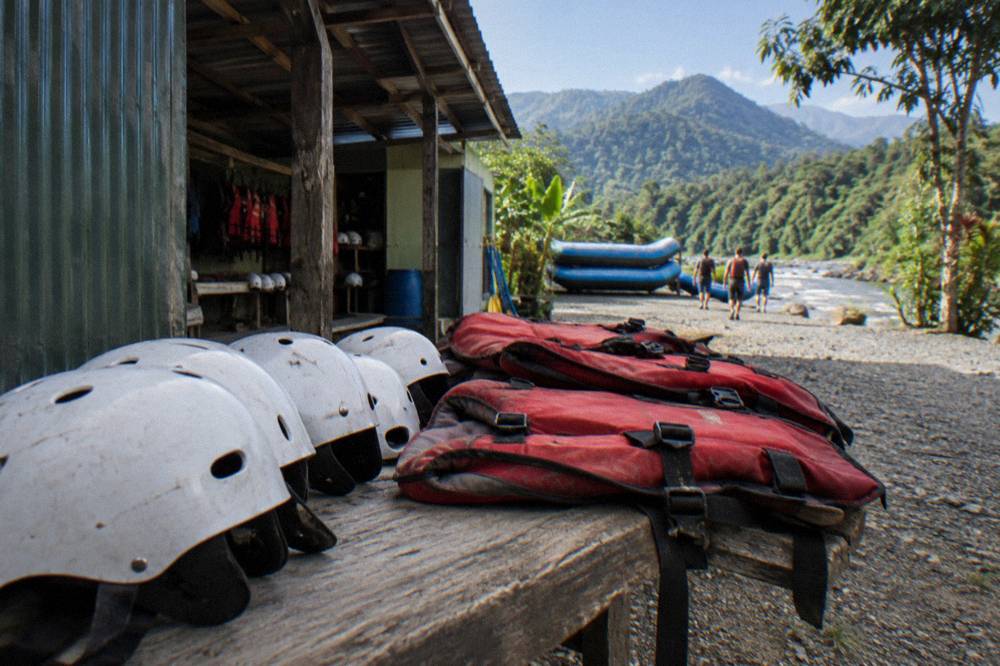
On commercial Pacuare trips, helmets and life jackets are mandatory from start to finish, including calm sections, and operators supply them: two Turrialba listings name helmets, life vests and paddles as included. Ticos River Adventures additionally lists a dedicated safety kayak and an insurance policy, and guides are reported to be trained in swift water rescue and to carry safety kits for the full trip.
The helmet-and-life-jacket rule is not negotiable culture, it is stated practice on operator pages, and it applies even in the flat stretches between rapids where a swim is less likely but still possible. Gear provision is one of the easiest things to verify on a listing before you book, because inclusion lists are printed on the product page. The most reviewed trip, Rafting Pacuare River One Day from Turrialba, states in its own words that it provides helmets, life vests and paddles. The Full Day Pacuare River Rafting Experience goes further and lists a safety kayaker, rafting equipment, a river guide and all fees and taxes among its inclusions, at from $124 per person.
A safety kayak is worth pausing on, because it is a structural safety feature rather than a piece of clothing. A kayaker paddling alongside the rafts can reach a swimmer quickly, hold position in the current, and help recover people and equipment, and listings that name one are telling you something concrete about how the trip is staffed. The Ticos River Adventures day trip from Turrialba, Pacuare River Rafting at from $119 per person, 4.9 from 27 reviews, lists a safety kayak, certified guides, gear and an insurance policy among its inclusions. If safety staffing matters to you, that listing is one of the clearest on the roster about what stands between you and the river.
Footwear is the part of the kit you control. Operator guidance is consistent: tennis shoes or secure sandals and river shoes that can get wet and muddy, and no flip-flops, which come off in the first rapid and end up in the Caribbean. Bring swimwear or quick-dry clothes, sunscreen, a towel and a change of clothes for the end. The general packing picture is covered in detail in our what to bring guide for Pacuare trips, and the clothing question in what to wear rafting in Costa Rica.
Is A Guided Trip Safer Than Going Independently?
Yes, by a wide margin, and not because guides are heroic but because the infrastructure is: a commercial Pacuare trip comes with a trained guide in every raft, mandatory helmet and life jacket, a pre-trip safety talk and paddle practice, on many listings a safety kayaker, and an operator reading the river level every morning with the authority to cancel or reroute. An independent paddler has none of that. Commercial trips are also capped by group size on many listings, which keeps the guide-to-guest ratio workable.
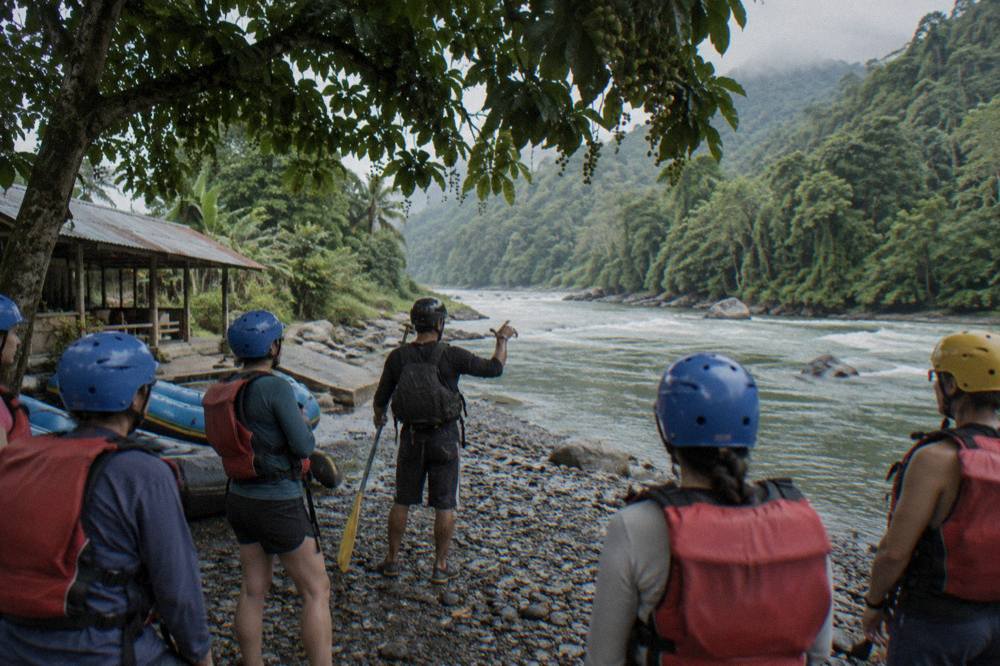
That answer comes with a caveat the industry itself makes: operators schedule a substantial safety talk and paddle practice immediately before the descent, on one published itinerary about 45 minutes, before roughly three hours on the water. That time exists because the raft's crew, meaning you, is part of the safety system. A guide cannot paddle a raft full of passive passengers through a Class IV drop; they call commands and the crew executes them. The talk is where you learn the commands, and the practice is where your body learns them. Treat it as part of the trip rather than a delay before it.
How Do Guides Handle A Swim Or A Flip?
Guides run a rehearsed protocol: a swimmer makes for the raft, ideally on its upstream side, grabs the perimeter line, and is pulled aboard by the guide and crew, while a safety kayaker, when one is on the water, reaches the swimmer first to assist. The pre-trip talk drills the white-water swim position, feet up, feet first, on your back, and never standing in moving current, since foot entrapment is the danger.
That paragraph compresses what guides spend the safety talk teaching, and it is worth uncompressing. In the swim position, your feet are on the surface, pointed downstream, so they bounce off rocks instead of snagging under them, and your arms steer you toward the raft or the eddy the guide is calling out. The reason you never stand up in moving water is that a foot wedged between rocks while the current pushes on your torso is one of the few situations in whitewater that turns bad very quickly. Every trained guide drills this because it is the one mistake untrained swimmers reliably make.
A flip or a swim is not a catastrophe on a commercial trip; it is an event the whole system is built around. Helmets protect against rock contact, the life jacket floats you high, the guide recovers the raft, and the kayaker, on listings that carry one, is already moving toward you. No honest writer can promise an injury-free trip, and this site does not print incident statistics.
What you can check before booking is whether the listing names its safety staffing and equipment at all. The roster makes this easy, and the table below summarizes the safety-relevant inclusions the listings themselves state, with the caveat that inclusions are the operator's own claims as printed on their pages.
| Listing | Departure | Rating and reviews | Price from | Safety-relevant inclusions stated on the listing |
|---|---|---|---|---|
| Rafting Pacuare River One Day from Turrialba | Turrialba | 5.0 from 385 reviews | $99 per person | Helmets, life vests, paddles, lunch, private transportation |
| Pacuare River Rafting | Turrialba | 4.9 from 27 reviews | $119 per person | Certified guides, safety kayak, gear, insurance policy |
| Full Day Pacuare River Rafting Experience | San Jose | 4.8 from 17 reviews | $124 per person | River guide, rafting equipment, safety kayaker, all fees and taxes |
| White Water Rafting Pacuare River From San José | San Jose | 4.7 from 250 reviews | $125 per person | Professional bilingual rafting guide, complete professional rafting equipment |
| From San José: Pacuare River Class 3 & 4 Rafting Day Trip | San Jose | 4.7 from 291 reviews | $125 per person | Tour guide, rafting equipment, transport from San José hotels |
The From San José Class 3 & 4 day trip, 4.7 from 291 reviews at from $125 per person, is the second most reviewed Pacuare listing on this roster and includes hotel pickup from San José along with rafting equipment and a guide, with free cancellation listed. It appears in the comparison band above. The other capital option is Destination Services Costa Rica's 10-hour San Jose trip, 4.7 from 250 reviews, from $125 per person, with pickup from selected hotels.
How Do River Levels And Season Change The Risk?
Operators report the Pacuare is runnable all year, with water highest and fastest from October to December and lowest from March to April, and the practical effect is that rapid difficulty shifts with the level: sources describe Class III rapids becoming Class IV in the rainy season and Class IV rapids easing to Class III in the dry. Some operators raise their minimum age from 12 to 14 between June and November precisely because of the higher water.
Season, in other words, is not a footnote to the safety question, it is half of it. The same physical rapid is a different experience at low water in March and at high water in October, and one major Pacuare operator describes its run as Class 4 at high water and Class 3+ at low. This site's dedicated season piece, the best time to raft the Pacuare, covers the month-by-month picture in full, including the ERA5 modelled rainfall averages for the Turrialba area, which show February to April as the driest stretch and October to December as the wettest.
For a first-time rafter, that translates into a simple planning rule: operators themselves prefer roughly February to April for first timers and families, because the water is lower and more predictable, while September to October draws some experienced rafters who want bigger water. Neither month is "safe" or "unsafe" in absolute terms; the higher-water months demand a slightly fitter, more confident crew and tolerate less hesitation in the paddle strokes. If you are booking a first trip and feel unsure, pick a dry-season date and a listing that names its gear and guides. The wider set of guides lives on Pacuare Costa Rica Rafting.
The cancellations question belongs here too, because it is the system working. Operators cancel or reroute in high water or flooding, and three of the five multi-day lodge listings on this roster set longer cancellation windows, three to six days before departure, rather than the 24-hour window most day trips use. A cancelled trip is a disappointing morning, not a safety failure; it is the norm's requirement to check river conditions being honored. Rain on your hotel roof in San Jose is not, by itself, a reason to expect a cancellation, because the river's response depends on the whole catchment, not one afternoon.
Who Should Think Twice Before Rafting Class III-IV Water?
Non-swimmers, anyone with a heart condition, pregnant guests, and people who would panic if they fell into moving water should think hard before a Class III-IV run. The national norm of ages 12 to 17 on Class I-IV water is a legal floor, not a fitness test, and some listings set weight limits or health restrictions.
That paragraph is deliberately blunt because it is the one place where the industry's marketing copy and a reader's actual interest can diverge. A Class III-IV gorge with waterfalls dropping from the walls and no road access along most of the run, which is how the standard Pacuare day is described, is a wilderness-adjacent activity. Help exists, in the form of guides, kayakers and safety kits, but the raft is powered by the people in it. The fitness and age-limits guide on this site goes deeper on the age question, including the operators that raise the minimum to 14 in wet months.
Families with younger children have a genuinely different decision, and it is covered fully in rafting with kids and teens. The short version is that the law's age ladder exists precisely so that a 9-year-old is not on Class IV water, and that the Pacuare roster's Class III-IV listings are built around the 12-and-over framework. For adults, the screening questions are fitness and water confidence, not age. One operator's listing outside this roster specifies a weight range of 45 to 90 kg and a minimum height of 1.35 m, which is a useful reminder that jacket fit and raft weight distribution are real operational constraints; this site's policy is to say "check the listing" for weight and size limits rather than quote numbers that vary by operator.
Beginners asking whether Class 4 is even possible for them should read our longer treatment of that exact question, can a beginner do Class 4 rapids. The safety-relevant summary is that the gorge's difficulty is managed by guide route choice and daily level reads, and that your own honesty about swimming ability and fitness matters more than any certification the operator holds.
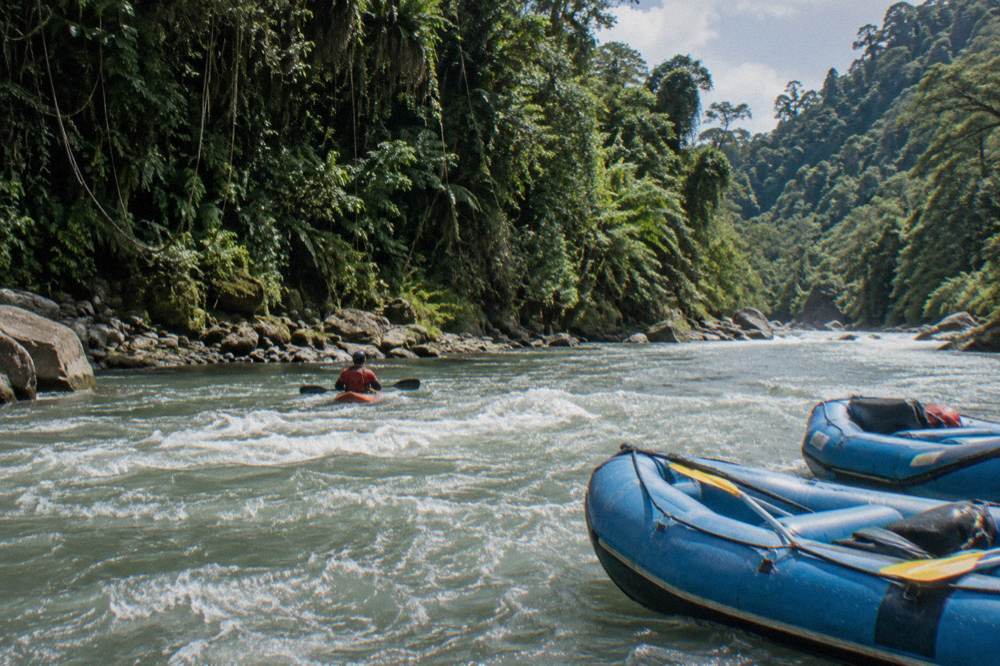
What Can You Do Yourself To Cut The Risk?
You can cut a large share of the risk yourself: attend the safety talk and practice the paddle commands, wear your helmet and life jacket for the whole trip, choose secure footwear over flip-flops, and follow the guide's calls without improvising. If you fall out, swim feet-first on your back, and before you pay, book an operator that names its gear, guides and safety staffing, and check the minimum age and any weight limits.
None of that is exotic, which is the point. The commercial system, the norm, the guide training, the equipment, handles the structural risks. What it cannot handle is a passenger who ignores the commands, takes the helmet off in a calm stretch, or panics standing up in current. Operators report that valuables such as cameras and phones brought on the raft are the participant's own responsibility, and optional professional photo services exist on several listings precisely so guests do not have to paddle with a phone in hand. The photo question, including operator rules on cameras, has its own page: Pacuare rafting photos and camera rules.
The other guest-side decision is operator choice, and the roster gives you the raw material. Beyond the inclusions table above, it is reasonable to weigh review volume, stated group sizes, and how explicitly a listing describes its safety setup. The private Pacuare River listing from Ticos River Adventures, 4.9 from 204 reviews at from $125 per person, is a private tour capped at up to 60 guests with hotel pickup not included, a different product from the same operator's shared Class III-IV day trip with the safety kayak. Reading two listings from the same operator side by side is often the fastest way to see which trip fits your risk appetite.
Beyond the river itself, the standard travel safety layer applies: travel insurance that covers adventure activities is a decision worth making before the trip rather than after. This site does not publish entry requirements or insurance figures, because they change and belong to the official immigration and tourism pages; check those directly for current rules.
What Should You Ask A Listing Before Booking?
Ask five checkable things: the minimum age stated on that specific listing, the gear included by name, whether a safety kayaker or second guide is on the water, the cancellation window, and the maximum group size. Your decision can rest on printed facts rather than reassurance; if a listing leaves one out, "check the listing" is the instruction, not a dodge.
Group size deserves a sentence of its own, because it is the ratio that governs how much attention your guide can give. The roster states caps ranging up to 200 guests on one large-format listing down to 10 on a small premium San Jose trip, with the most reviewed Turrialba day capped at up to 40 and the Class IV Turrialba trip capped at up to 18. Smaller is not automatically safer, but smaller means the safety talk lands better, commands carry further, and a swim is noticed faster. Readers comparing group sizes across all 21 listings can use the full Pacuare trips comparison on this site.
The cancellation question is also a safety question in disguise. A day listing with free cancellation lets you reassess if the forecast turns, and a lodge trip with a three-to-six-day window simply reflects that the operator is holding beds and food in a roadless gorge. Neither window tells you the river's condition on the day; the operator's morning call does that. But a booking you can unwind cheaply is one fewer reason to run a trip you no longer feel good about, which is a real safety margin even though it never appears in a gear list.
If you have read this far, you have done the part of the safety work that is yours to do: you know the regulation exists and what it requires, you know the gear and staffing to look for, and you know the season moves the river. The remaining step is picking the trip that matches your confidence and your dates.
Common Questions About White Water Rafting Safety In Costa Rica
How Safe Is White Water Rafting In Costa Rica?
No verified official rafting-specific incident statistic for Costa Rica exists to quote, so the honest measure is the framework: a national technical norm sets minimum ages by rapid class and requires operators to check river conditions, helmets and life jackets are mandatory on commercial trips, guides are trained in swift water rescue, and operators cancel or reroute in high water. No operator or honest writer can promise a risk-free trip.
Has Anyone Died Rafting The Pacuare?
Incidents have occurred on the river over the decades, but this site does not publish named incidents or fatality statistics, because no verified official rafting-specific figure for Costa Rica exists to cite. The fatality-rate question is treated honestly, with the same finding of no official figure, in our dedicated article on the fatality rate of whitewater rafting.
Do You Need To Be Able To Swim To Go Rafting?
The life jacket floats you, but water confidence matters on Class III-IV water. If you cannot swim or would panic in moving water, a high-volume jungle run like the Pacuare deserves a hard second thought. Check the listing's stated requirements before booking.
What Is The Minimum Age For Rafting In Costa Rica?
Under the national norm INTE G60-1:2019, ages 12 to 17 may run Class I to IV water and 18 and over may run Class V, so the legal floor for the Pacuare's Class III-IV run is 12. Some operators raise their own minimum to 14 between June and November when water is higher. Always check the specific listing, because operator minimums vary.
What Happens If You Fall Out Of The Raft?
You float on your back, feet up and pointed downstream, hold the raft's perimeter line, and the guide and crew pull you back in, with a safety kayaker reaching you first on listings that carry one. The pre-trip safety talk rehearses exactly this. Never try to stand in moving current, because foot entrapment is the specific hazard the feet-up position exists to avoid.
Is The Pacuare Safer In Dry Season?
Operators describe lower, more predictable water from February to April and higher, faster water from October to December, with rapid difficulty shifting by roughly half a class between the two. Dry season is generally the more comfortable choice for first timers and families, but no season makes the river risk-free, and operators run it all year with daily level checks.