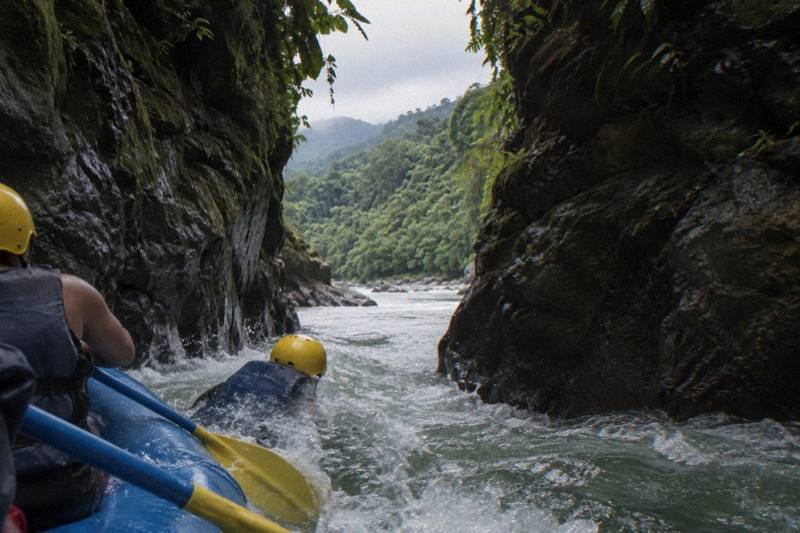
Class III-IV Pacuare Rapids: What The Gorge Really Feels Like
The Pacuare's commercial run is rated Class III-IV, but that single label hides a gorge that tightens, drops and changes personality with every rainfall. Here is what the rating means, which rapids set it, and how to judge whether you can handle it.
Short answer
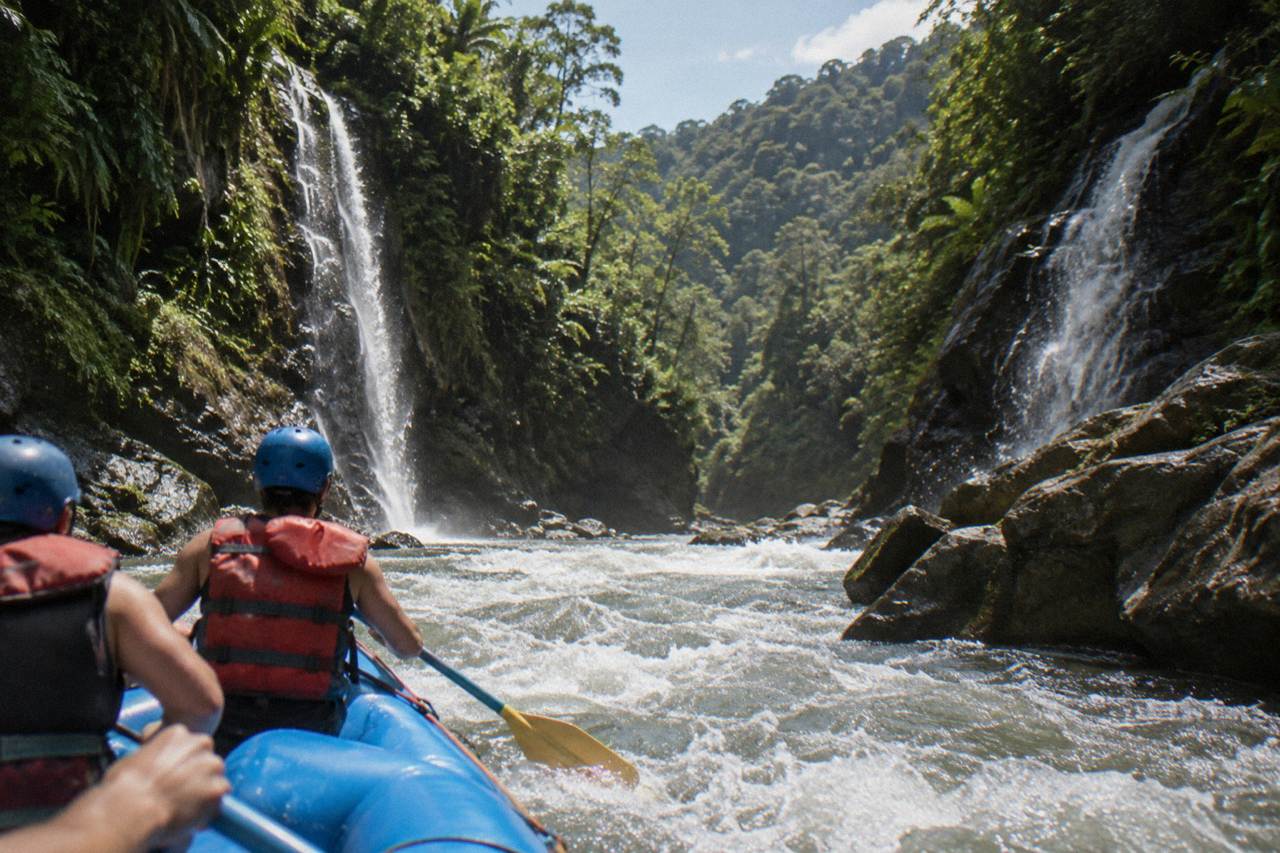
The standard commercial Pacuare run is Class III-IV: mostly continuous Class III with named Class IV rapids, including Upper and Lower Huacas and Cimarrones in the Huacas River Gorge. Exploradores Outdoors grades it Class 4 at high water and Class 3+ at low water. Day trips on the roster run from $99 to $195 per person depending on departure town.
The Pacuare carries a Class III-IV rating on its commercial run, and that is the honest headline: a river of mostly sustained Class III water punctuated by genuine Class IV drops in the Huacas River Gorge, where the canyon narrows, the gradient steepens and waterfalls spill straight off the walls. Operators do not market it as gentle. They market it as the flagship jungle-canyon run of Costa Rica's Caribbean slope, and the rating is the reason first timers with reasonable fitness book it while nervous swimmers think twice. If you're a first timer wondering whether water like this is within reach, our plain answer on beginners and Class 4 rapids walks through the guide practices and age rules that make the call.
This page breaks the label apart. It covers how the river is graded section by section, which named rapids set the Class IV tone, what actually happens if you fall out, how the same rapid can shift half a class between March and November, and how the Pacuare compares with the Reventazon, Sarapiqui and Balsa on paper. The Class IV Turrialba trip, from $125 per person, is the roster's most explicit Class IV product, and the most reviewed Turrialba day trip, 5.0 from 385 reviews at from $99 per person, runs the same gorge. If you want the wider decision instead, Pacuare Costa Rica Rafting compares every departure town and trip length side by side.
What Class Are The Pacuare River Rapids?
The commercial Pacuare run is rated Class III-IV: sustained Class III rapids broken by named Class IV drops, concentrated in the Huacas River Gorge. The grade shifts by season: one operator, Exploradores Outdoors, describes it as Class 4 at high water and Class 3+ at low water, so one river label covers a real range. No section of the standard commercial run reaches Class V.
Rapid classes run from I to VI. Class I is moving flat water, Class II is easy ripples with wide channels, Class III is moderate whitewater with waves, holes and maneuvering that a trained crew can read from the raft, Class IV is powerful, steep and technical with consequences that require precise paddling, Class V is expert-only danger, and Class VI is not run commercially. The Pacuare's commercial day sits squarely in the III-IV band, which in Costa Rica's national rafting norm makes it legally accessible from age 12, a point covered in detail further down this page.
The river splits into about sixteen sections in total, three of which are commonly run. The Upper Upper stretch runs about 26 km at Class II to IV. The Upper section is Class IV and V with waterfalls and is mostly paddled in creek kayaks rather than rafts. The Lower Pacuare, the stretch the day trips use, is Class III and IV, about 37 km from the Finca La Cruz area down to Siquirres, dropping roughly 370 m along the way, according to the river's standard reference entry. Guests on every roster day trip, from the San Jose departures to the Puerto Viejo departure, are rafting that Lower section or a similar operator-chosen stretch of it.
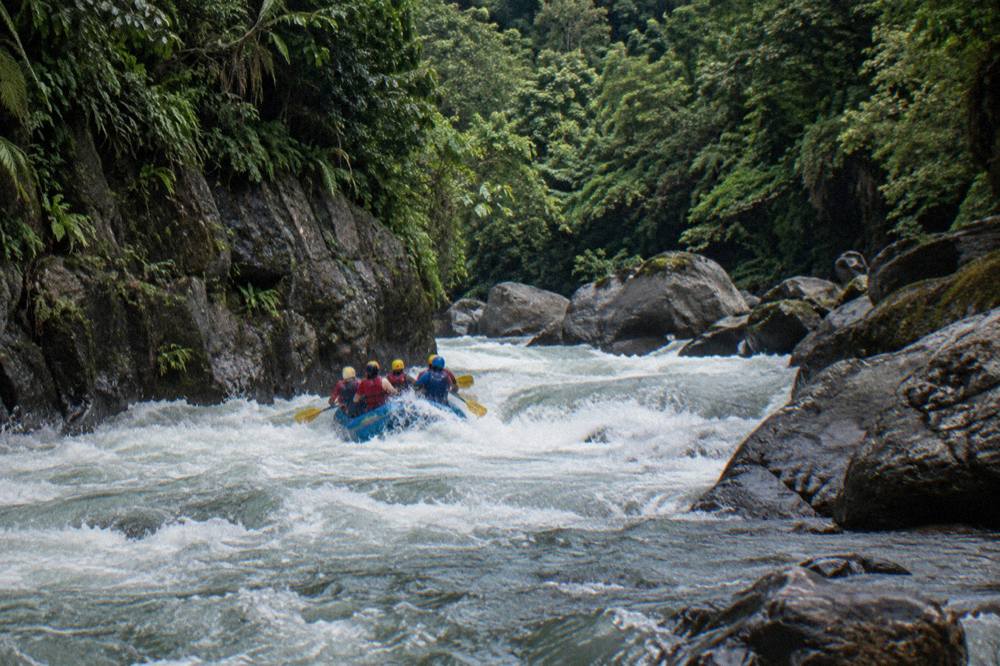
What the label does not tell you is how continuous the Pacuare feels. This is not a pool-and-drop river where you drift between rapids. Operators describe the standard run as continuous Class III-IV through a gorge with waterfalls dropping from the walls and no road access along most of the run. That isolation is the draw for many guests and the reason the rating deserves respect: once you are in the gorge, you are in it until the take-out.

| Pacuare section | Approximate length | Rapid class | Who runs it |
|---|---|---|---|
| Upper Upper | About 26 km | Class II to IV | Some multi-day and higher put-in trips |
| Upper | About 16 km (10 mi) | Class IV and V, waterfalls | Mostly creek kayakers, not commercial rafts |
| Lower (commercial day) | About 37 km to Siquirres | Class III and IV | Nearly all roster day and overnight trips |
What Are The Named Rapids On The Pacuare River?
The named Class IV rapids on the Lower Pacuare include Upper and Lower Huacas and Cimarrones, all inside the Huacas River Gorge, alongside Class III waves such as Doble Drop. Operators commonly name Huacas, Pele el Ojo and Cimarrones in their day trip descriptions. Names mark the drops that define the run's character and its biggest water.
The gorge is where the trip's story happens. The Huacas River Gorge pinches the Pacuare between dark rock walls, and inside it the gradient stacks the named drops close together. Upper and Lower Huacas are the signature Class IV pair. The Huacas waterfall itself drops about 150 feet directly into the river channel. Cimarrones is another Class IV, and Doble Drop is Class III.
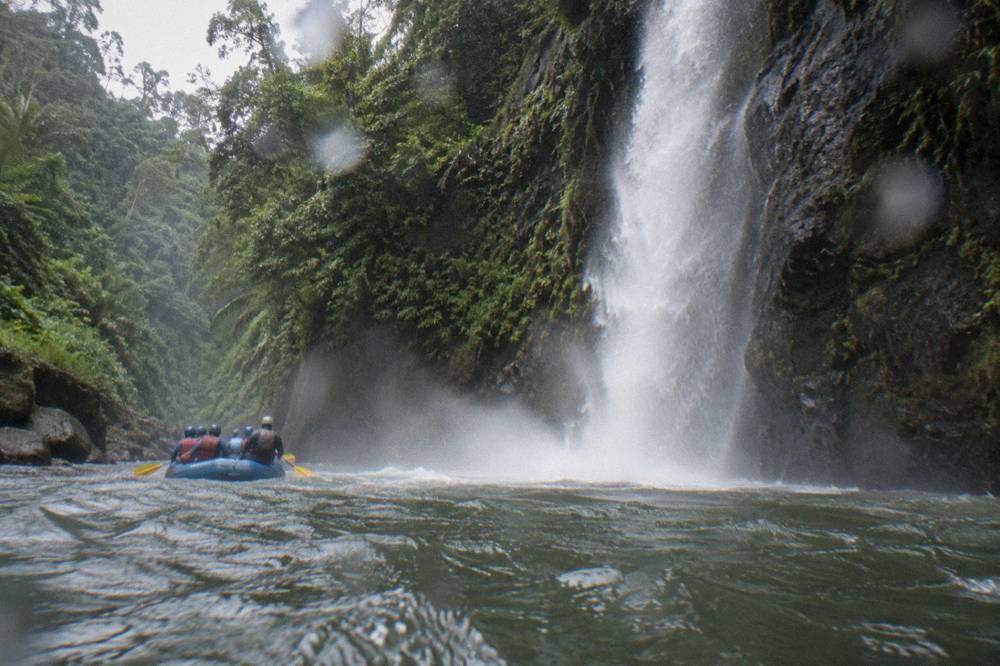
No operator promises you a specific rapid at a specific intensity. Water level reshapes each drop, and operators reroute or walk rafts around features when flow demands it, which the national rafting norm explicitly requires them to scout for. What the names give you is a map of the run's punctuation: long stretches of read-and-run Class III, then a named Class IV where the guide shouts a plan, the boat tightens, and the gorge does its worst.
Booking the run is simpler than grading it. The two listings below cover the Class IV Turrialba trip and the Ticos River Adventures four-hour run from Turrialba.
Between the two, it is worth knowing that the named rapids sit inside a canyon with no road along most of it, so a swim, a stuck raft or a weather hold is handled on the water, by the guides, with the gear they carry. Pacuare guides are trained in swift water rescue and carry safety kits for the full length of the trip, and that life jackets and helmets are mandatory for the entire trip, including all calm sections. That is the system working as designed.
| Named rapid | Typical class | Character |
|---|---|---|
| Upper Huacas | IV | Inside the Huacas River Gorge |
| Lower Huacas | IV | Inside the Huacas River Gorge |
| Cimarrones | IV | Inside the Huacas River Gorge |
| Doble Drop | III | Inside the Huacas River Gorge |
| Pele el Ojo | Not published | Named in operators' day trip descriptions |
What Happens If You Swim On A Pacuare Class IV Rapid?
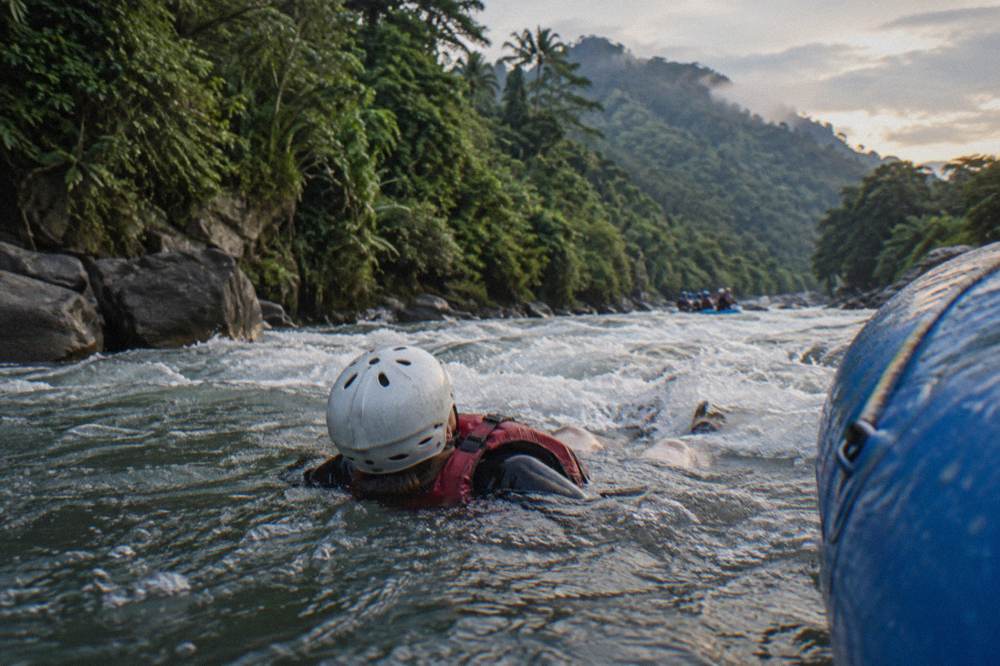
Falling out, what rafters call swimming, is a normal part of Class III-IV rafting and operators plan for it: you float on your back, feet up and pointed downstream, hold your paddle if you can, and let the safety kayaker or the raft pick you up. The trips carry dedicated safety support, but no honest operator will promise you will stay in the boat.
The technique is standard whitewater practice and every operator drills it before launch. Feet up matters most: in rocky Class III-IV water a planted foot can catch, which is how entrapment happens, so you keep your legs at the surface, lean back, and let the current carry you to the raft or the safety kayaker. One operator schedules a full safety talk and paddle practice immediately before the descent, and at least one Turrialba operator, Ticos River Adventures, includes dedicated safety kayak support on its Pacuare trips. The roster's Class IV Turrialba listing caps its trips at 18 guests, which keeps the guide-to-guest ratio workable in the gorge.
Swim risk is the honest answer to "can I handle it." If floating down a rapid in a helmet and life jacket, bounced around but corralled within a minute or two, sounds tolerable, the Pacuare's Class III-IV rating fits you. If it sounds intolerable, a gentler run elsewhere in the country serves you better, and the comparison section below covers those options.
The gear rules back all of this up. Operators provide the helmet, life jacket and paddle, and require them worn throughout, calm sections included. Footwear is on you: operator guidance recommends tennis shoes or secure sandals and river shoes that can get wet and muddy, and bans flip flops outright. Bring a strap for glasses, leave the phone behind or in a dry bag, and treat anything you carry on the raft as your own responsibility; several operators sell photo packages precisely so you do not have to.
How Does The Pacuare's Class III-IV Compare To Other Costa Rica Rivers?
The Pacuare is the country's flagship Class III-IV jungle-canyon run: harder and longer than the Class II-III family rivers, similar on paper to Sarapiqui's Class III-IV sections but bigger and more remote, and well short of the Class IV-V expert water on the Reventazon's Pascua section. Costa Rica splits roughly into Caribbean-slope and Pacific-slope rafting, and the Pacuare anchors the Caribbean side.
The Reventazon, the Pacuare's Caribbean-slope neighbor, shows how wide one river's range can be: its lower and Tucurrique sections run Class II-III with minimum ages as young as 6, while its Pascua section is Class IV-V for experienced rafters only, per the national tourism board's rafting overview. The Sarapiqui in the northern lowlands offers Class III-IV sections with shorter, punchier rapids plus calmer wildlife stretches. The Balsa River near La Fortuna is the family option, typically Class II-III with minimum ages of 6 to 8. On the Pacific side, the Savegre runs Class II-III while the Naranjo runs Class III-IV but only roughly June to November. If you're weighing the Pacuare against these options, our guide to the Pacuare's rating explains which sections carry which class and who each run suits.
This site sells only Pacuare trips, so the comparison is here to place the rating, not to redirect you. On the roster, the San Jose Caribe Arenal Pacuare 1-Day Rafting Adventure is listed as Class II-IV, the widest band of any day listing, while the Class 3 and 4 San Jose day trip, 4.7 from 291 reviews at from $125 per person, names the standard band outright. Neither is a different river; the bands reflect how each operator describes the same water at different levels. If you are weighing one Caribbean-slope run against another in detail, the Pacuare versus Reventazon comparison and the Pacuare versus Sarapiqui breakdown do it rapid by rapid.
| River | Typical commercial class | Slope | Character |
|---|---|---|---|
| Pacuare | III-IV | Caribbean | Long jungle gorge, waterfalls, no road access |
| Reventazon (lower/Tucurrique) | II-III | Caribbean | Gentler, family-accessible sections |
| Reventazon (Pascua) | IV-V | Caribbean | Experienced rafters only |
| Sarapiqui | III-IV | Caribbean/northern lowlands | Shorter, punchier rapids plus calm stretches |
| Balsa | II-III | Northern/Arenal | Family-friendly, low minimum ages |
| Savegre | II-III | Pacific | Scenic, gentle |
| Naranjo | III-IV | Pacific | Seasonal, roughly June to November |
Is The Gorge Harder At High Water Or Low Water?
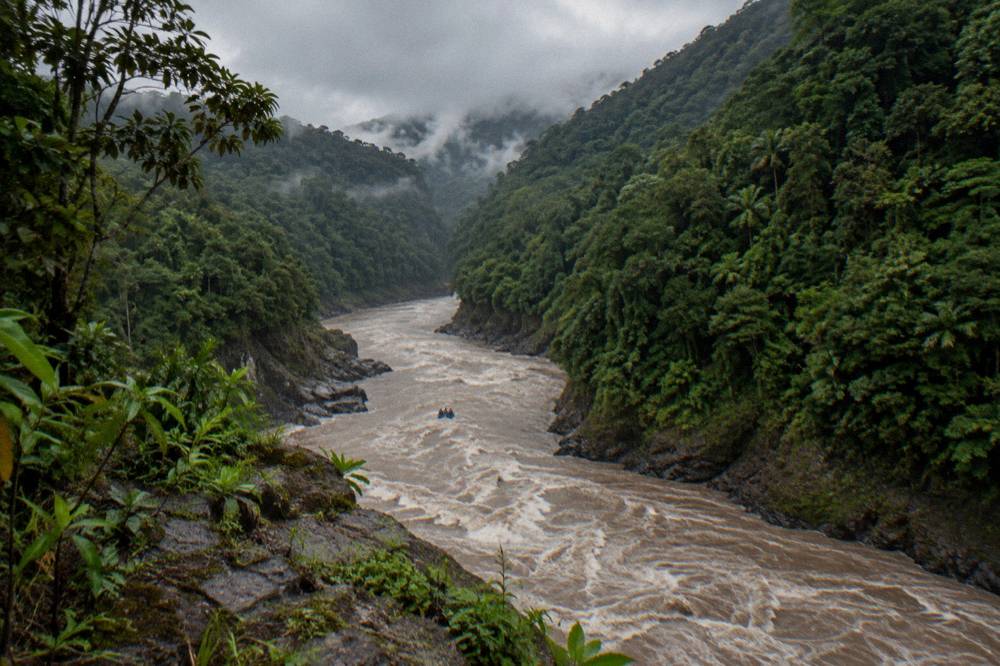
The gorge is harder at high water: rafting guides describe many Class III rapids becoming Class IV in the rainy season and Class IV drops easing toward Class III in the dry season, with operators grading the run roughly half a class up in the green season. Water is highest and fastest October to December and lowest March to April, and the river is runnable all year.
The Pacuare is rain-fed, and the rating printed on a listing is a band, not a constant. Operators describe February to April as the sweet spot for first timers and families: enough water for exciting rapids without swollen conditions that raise the difficulty. September to October draws some experienced rafters precisely because the water is bigger, though afternoon thunderstorms are more likely then. Modelled rainfall averages for the Turrialba area, from the ERA5 archive, run from about 181 mm in March to about 477 mm in November, and the wettest months stack neatly onto the highest-water window. Because there is no automated flow gauge on the river, operators read painted rock markers and their own scouting, and the published flow guidance describes exactly that marker system.
Operators cancel or reroute in high water or flooding rather than run a gorge beyond its band, so a booking in the wet months carries a small chance of a changed plan rather than a dangerous trip. Some raise their minimum age from 12 to 14 between June and November specifically because the water runs higher; one operator does exactly that while keeping 12 from December to May. If your travel dates are fixed in the wet season and the rating worries you, the Turrialba departures cut the drive and the San Jose hotel-pickup listings such as White Water Rafting Pacuare River From San José, 4.7 from 250 reviews at from $125 per person, keep the logistics simple on a long day.
Season choice also changes what the same dollar buys in feel, not in price: the roster's day prices hold steady across the calendar, from $99 per person on the most reviewed Turrialba trip to $195 on the Authentic Pacuare River Costa Rica Rafting Tour from San Jose. The month changes the water, the water changes the class, and the class changes the story you tell afterward. The best time to raft the Pacuare guide walks the full calendar month by month.
| Window | Water level | What it means for the rating |
|---|---|---|
| February to April | Lowest, most predictable | Operators prefer it for first timers and families |
| May to August | Rising | Roughly half a class harder than dry season |
| October to December | Highest and fastest | Some Class III becomes Class IV; operators may reroute or cancel |
Who Can Legally Book A Class IV Pacuare Trip?
Costa Rica's national rafting norm sets the legal minimum age for Class I to IV water at 12, and 18 and over may run Class I to V, so the Pacuare's Class III-IV day trips are legally open from age 12. Operators may and do set their own higher minimums, some raising the bar to 14 in the wet months, so the listing's own stated minimum age always governs the booking. Legal minimums aside, whether a child is actually ready for water this pushy is a separate question, and which rafting trips really suit younger paddlers answers it in plain terms.
The norm, INTE G60-1:2019, reads plainly: under 5 runs no class, ages 5 to 7 run Class I and II, ages 8 to 11 run Class I to III, ages 12 to 17 run Class I to IV, and adults 18 and over run Class I to V. The full technical norm PDF also requires operators to publish minimum ages by class, check weather and river conditions, and scout when flow rises. In the roster, the listings that state a minimum age say 12: White Water Rafting Pacuare River From San José, the Pacuare River Whitewater Rafting from San Jose trip, the Day Trip to Pacuare River Rafting Class III-IV from San Jose, and the Puerto Viejo departure all carry it. The Turrialba listings mostly leave the age as "check the listing", which is the right instruction to follow.
Beyond age, fitness is the practical gate. Paddling the gorge means sustained effort in waves, following commands quickly, and bracing through drops, all while soaked. You do not need athletic training, but you need honest swimming comfort and the ability to haul yourself back toward a raft. Operators also set weight and chest-size limits for life jacket fit on some listings; one San Jose operator not on this roster, Nomades, requires participants to weigh 45 to 90 kg and stand at least 1.35 m tall, and the rest leave limits to the listing. Check weight and age lines before booking rather than at the riverbank.
For families weighing it up, the Pacuare rafting age limits and fitness guide covers the cutoffs in full, and the broader safety picture, including what no official statistic can tell you, sits in is Pacuare River rafting safe.
What Does The Class IV Turrialba Trip Actually Include?
The Class IV Turrialba trip, operated by Turrialtours from Turrialba at from $125 per person, lists an 8-hour day with life jackets, helmets and paddles included, lunch, and private transportation, capped at 18 guests. It carries 4 reviews so far, rated 5.0.
Of the 21 listings on this roster, this is the only day trip that names Class IV alone in its own title, which makes it the natural pick for a reader who has read this far and wants the steepest version of the gorge without ambiguity. It departs Turrialba, so it skips the San Jose transfer and the early hotel pickup entirely. Its 8-hour total duration is the listing's own figure, which includes transport, the safety talk, the descent and lunch, not time on the water alone. Cancellation is listed as free, and gratuities and travel insurance sit on the exclusions side of the listing.
Two Turrialba neighbors make useful contrasts. Pacuare River Rafting, run by Ticos River Adventures, 4.9 from 27 reviews at from $119 per person, is listed as Class III-IV with a deli-style lunch, beverages, certified guides, a safety kayak and an insurance policy included, plus transport from Turrialba or nearby areas. And Rafting Pacuare River from Turrialba, run by Explornatura, 5.0 from 196 reviews at from $120 per person, lists a 6-hour day for up to 24 guests with lunch and transfer from Turrialba included. Same river, same band, three different packages: the class rating tells you the water, the listing tells you the rest.
Can A Beginner Run The Pacuare's Class III-IV Water?
Yes, in the normal case: the Pacuare's commercial run is built for first-time paddlers, and guests and operators alike describe it as beginner friendly at lower water. The honest conditions are reasonable swimming comfort, willingness to take a possible swim, and picking the dry-season window if you are nervous.
One traveler described the river as very beginner friendly in May with lower water levels, and operators consistently point beginners and families toward February to April. The structure of a commercial trip carries you: a trained guide calls every command, the raft's weight and design absorb most of what the river throws, and the safety kayaker covers the rest. Your job is to paddle forward, paddle hard, stop, and hold on, in that order, when told.
The genuine contraindications are specific rather than general: a real fear of deep or moving water, an inability to swim at all, back or shoulder conditions that a hard paddle stroke would aggravate, and, in the wet months, ages under the operator's raised minimum. If any of those apply, the Class II-III family rivers elsewhere in the country exist precisely for you, and this site's roster is honest that its river is the III-IV one. The first time Costa Rica adventure planning guide places the Pacuare inside a wider first trip, and the one day Pacuare trip guide walks a full first-timer day from pickup to take-out.
Between the ratings, the seasons and the named rapids, the decision usually reduces to a simple test. If you read about Upper Huacas and felt your stomach drop with excitement, book the gorge. If you read about it and felt your chest tighten, pick a drier month, a Turrialba departure, or a calmer river, and save the Pacuare for a braver version of yourself.
Common Questions About Class III-IV Pacuare Rapids
What Class Are The Pacuare River Rapids?
The commercial Pacuare run is Class III-IV: mostly continuous Class III with named Class IV drops including Upper and Lower Huacas and Cimarrones in the Huacas River Gorge. Exploradores Outdoors grades it Class 4 at high water and Class 3+ at low water.
What Happens If You Swim On A Pacuare Class IV Rapid?
You float on your back with feet up and pointed downstream, hold your paddle if you can, and wait for the raft or safety kayaker to collect you. Swims are a normal part of Class III-IV rafting, and operators carry safety kayaks, trained guides and full safety kits for exactly this.
Is The Gorge Harder At High Water Or Low Water?
Harder at high water. Many Class III rapids become Class IV in the rainy season and ease back in the dry season, roughly half a class of difference. Water is highest October to December, lowest March to April, and the river runs all year.
Can A Beginner Run The Pacuare's Class III-IV Water?
Normally yes. The trip is built for first-time paddlers, and operators point beginners toward February to April for the most predictable water. You need reasonable swimming comfort and tolerance for a possible swim.
What Is The Minimum Age For Class IV Pacuare Rafting?
Costa Rica's national rafting norm sets the legal minimum at 12 for Class I to IV water. Operators may set higher minimums, and some raise the age to 14 between June and November, so check the listing's own stated age before booking.